
Tag Archive for: Manufacturing

Sales in the manufacturing sector isn’t simple. Long sales cycles, multiple decision-makers, and high-ticket solutions mean you can’t just wait for leads to come in. You have to proactively get in front of the right people.

That’s where B2B appointment setting comes in.

If you’re asking, “What is B2B appointment setting?” think of it as the structured process of connecting your sales team with qualified prospects at businesses that match your ideal customer profile. It’s not cold calling. It’s a strategic outreach designed to drive real conversations that lead to revenue.

What You’ll Learn

This guide will walk you through:

  • What B2B appointment setting actually means
  • Why it’s critical for manufacturing companies
  • How to implement and scale an effective appointment setting program
  • Common pitfalls and how to avoid them

Let’s dive in.

Why Appointment Setting Matters for Manufacturers

Manufacturers face unique sales challenges:

  • Complex buying processes involving engineers, procurement, operations, and finance
  • Long sales cycles that require trust and repeated engagement
  • Technical products that require detailed discovery and demos

B2B appointment setting helps manufacturers:

  • Proactively reach decision-makers before the competition
  • Build consistent sales pipeline without relying on inbound traffic
  • Qualify leads faster and get more value from sales resources
  • Support expansion into new verticals, geographies, or product lines

In short: It’s the missing piece between marketing and sales that ensures your best prospects don’t slip through the cracks.

What Does B2B Appointment Setting Include?

At a high level, appointment setting involves these core activities:

  1. Identifying and targeting the right companies (based on firmographics and intent data)
  2. Researching decision-makers and their roles
  3. Crafting personalized outreach via phone, email, and LinkedIn
  4. Engaging prospects with value-first messaging
  5. Qualifying leads based on fit, need, and buying window
  6. Booking meetings directly into your sales team’s calendar

Unlike general lead generation, appointment setting focuses on booking meetings, not just handing off unqualified contacts.

How Appointment Setting Works in the Manufacturing Sector

In manufacturing, the appointment setting process needs to be tailored for:

  • Complex solutions that often require plant visits, engineering input, or custom quotes
  • Multiple stakeholders with different priorities (efficiency, compliance, cost, etc.)
  • Seasonality and long buying cycles

Let’s say you offer industrial automation software. A good appointment setting strategy would:

  • Target Operations Directors at mid-size manufacturers in food processing and packaging
  • Use messaging that focuses on reducing downtime and improving line productivity
  • Reach out with a multi-touch sequence across email, phone, and LinkedIn
  • Qualify for current systems, pain points, and openness to change
  • Schedule a discovery call between the prospect and your product consultant

Every touchpoint is strategic. The goal is a quality meeting, not just a name in the CRM.
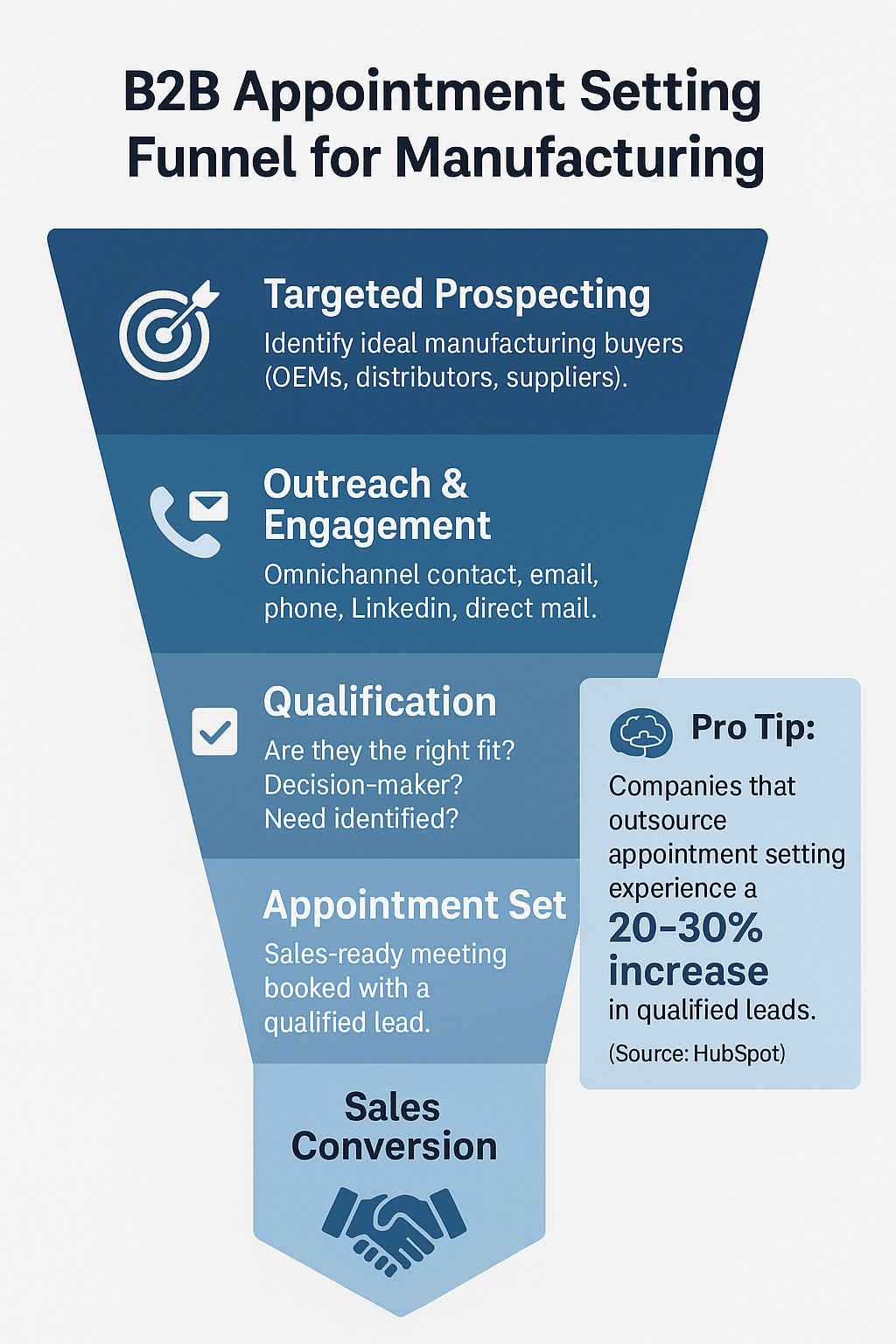
Build Your Appointment Setting Strategy: Step by Step

1. Define Your Ideal Customer Profile (ICP)

Start with clarity. Who is the right fit for your solution? Define your ICP by:

  • Industry verticals
  • Company size and revenue
  • Number of locations or plants
  • Pain points or use cases

The clearer your ICP, the more accurate your targeting. This foundation is crucial before launching any outbound effort. If your team calls or emails the wrong prospects, even the best messaging won’t deliver results.

2. Build a Target Prospect List

Build a contact list using LinkedIn, ZoomInfo, or industry directories. Focus on the right roles, such as Plant Managers, Engineering Leads, Procurement Directors, etc.

When possible, enrich your data with:

  • Company tech stack or equipment used
  • Recent hiring trends (indicating growth)
  • Mentions in trade publications
  • Current vendor relationships

This additional information helps tailor outreach and increases the odds of a response.

3. Craft Multi-Touch Outreach Campaigns

A typical cadence might include:

  • Day 1: Personalized email
  • Day 3: Phone call + voicemail
  • Day 5: LinkedIn connect
  • Day 7: Follow-up email with valuable resource (e.g., case study)
  • Day 10: Second call attempt

Don’t be afraid to iterate. A/B test subject lines, call scripts, and offers to see what resonates. The right message to the right contact at the right time can open even the toughest doors.

4. Qualify Before You Book

Appointment setting isn’t about booking every meeting—it’s about booking the right meetings. To qualify leads, use a basic BANT (Budget, Authority, Need, Timeline) framework.

You can also ask open-ended questions like:

  • What are your top production goals this quarter?
  • Are you currently evaluating any solutions in this area?
  • What would success look like six months from now?

These not only qualify the lead but also arm your AE with insights for a stronger discovery call.

5. Coordinate the Handoff to Sales

Once a meeting is booked, include:

  • Calendar invite with confirmed time and participants
  • Brief prospect notes: company background, key challenge, what they want to discuss
  • Relevant collateral: case studies, product sheets, technical specs

Pro tip: set up a shared Slack channel or CRM notification so your sales rep gets real-time updates. Tight communication ensures smooth transitions and better conversion.

6. Track Results and Optimize

Track key metrics:

  • Connect rates
  • Conversion to qualified meetings
  • No-show rate
  • Close rate from appointments

Beyond the numbers, gather qualitative feedback from your sales team:

  • Were the leads well-informed?
  • Was the prospect truly a fit?
  • What objections came up most often?

Use this feedback loop to fine-tune your targeting, messaging, and qualification criteria.

Integrating Appointment Setting Into Your Sales Playbook

When appointment setting is integrated properly, it doesn’t feel like a separate initiative—it becomes a vital engine in your growth strategy.

Best practices include:

  • Aligning marketing and sales around shared ICP definitions
  • Using appointment setting to test messaging and value propositions before broader campaigns
  • Creating a feedback loop between SDRs and AEs to close gaps
  • Reviewing campaign performance monthly and optimizing based on pipeline contribution

Many manufacturers find that appointment setting becomes the proving ground for product-market fit in new territories or verticals.

When Should Manufacturers Launch Appointment Setting?

You don’t need to wait until you’re scaling. In fact, earlier implementation often accelerates product feedback and customer acquisition.

Consider launching if:

  • Your sales team is struggling to hit pipeline goals
  • You’re entering a new market segment
  • Your inbound leads are inconsistent or unqualified
  • You want faster insights into buyer needs and objections

With a reliable appointment setting partner like Sapper, you can deploy campaigns within weeks—not months—and begin filling your calendar with real opportunities.

What Makes a Great Appointment Setting Partner?

Outsourcing can deliver speed and scale, but only if you choose the right team.

Look for a partner who:

  • Understands the B2B manufacturing space
  • Provides detailed reporting and performance insights
  • Uses real human outreach (not just automated email blasts)
  • Offers dedicated resources aligned to your brand voice
  • Can pivot quickly based on market shifts or campaign learnings

Sapper brings all of this to the table, plus deep manufacturing experience that allows us to speak your buyer’s language and surface high-quality opportunities.

Real-World Impact: Results from Sapper Clients

Here are just a few examples of how appointment setting drives growth:

Case Study 1: Packaging Equipment Manufacturer

  • Challenge: Needed more meetings with food and beverage plant managers
  • Solution: Sapper launched a tailored campaign targeting regional processors
  • Result: 25 meetings booked in the first 60 days, $2.3M pipeline generated

Case Study 2: Custom Fabrication Firm

  • Challenge: Struggled to expand outside of local accounts
  • Solution: Built a regional outreach strategy focused on OEM buyers
  • Result: Doubled monthly meetings and won 3 new six-figure accounts in Q2

Case Study 3: Industrial IoT Provider

  • Challenge: Needed to validate market demand before full product launch
  • Solution: Appointment setting campaign targeting automation engineers
  • Result: 40% meeting-to-opportunity conversion, direct insights for product roadmap

These are not edge cases. With the right strategy, appointment setting delivers consistent pipeline and predictable growth.

Final Thoughts

If you’re still wondering what is B2B appointment setting, here’s your answer: It’s the systematic process of generating qualified meetings with the right prospects so your sales team can focus on closing.

For manufacturers navigating long sales cycles and complex decision-making units, it’s not optional. It’s essential.

Looking to build a better appointment setting program? Talk to Sapper. We help manufacturers fill their pipeline with sales-ready leads that convert.

Book a call and see what a predictable sales calendar can do for your business.

Manufacturing sales isn’t just about driving demand—it’s about focusing that demand in the right direction. If you’re selling across multiple states, qualifying leads becomes even more critical. Each region brings its own operational quirks, buying behaviors, and decision-making structures. Without a consistent, thoughtful qualification process, your sales team spends hours chasing prospects who will never buy, can’t buy, or aren’t worth closing.

In this guide, we’re breaking down how to qualify leads in manufacturing sales, step by step. Whether you’re the VP of Sales overseeing multiple territories or a sales manager focused on building a tighter pipeline, this framework will help you zero in on your best-fit opportunities and maximize your close rate.

Why Lead Qualification Is Essential in Manufacturing Sales

If you’ve worked in manufacturing sales, you already know how expensive it is to chase the wrong lead. Long sales cycles, large technical investments, and highly specific needs mean that one poor-fit prospect can waste months of your team’s time. Multiply that by several territories, and the opportunity cost starts to balloon.

The stakes are higher in multi-state sales environments. Buying committees vary from region to region, procurement processes differ, and even regulatory requirements can impact whether or not you’re a viable solution. For manufacturers, proper qualification is the difference between building a clean, scalable pipeline or burning out your sales team with constant dead ends.

A strong qualification process saves time, reduces friction between sales and marketing, and gives you the confidence to invest resources into deals that are actually winnable.

Step 1: Know Exactly Who You’re Targeting

Before qualifying a lead, you need a crystal-clear picture of your ideal customer profile (ICP). This isn’t just about industry or company size. For manufacturing, it means understanding operational complexity, facility distribution, production capabilities, and supply chain priorities.

Let’s say your company manufactures automation components for food and beverage processors. An ideal customer might be a multi-facility operation with at least $50M in annual revenue, located within your service radius, and actively investing in process improvement initiatives. These are the kinds of factors that define a high-fit customer, not just someone who clicked a link in your last email campaign.

Your ICP should include both company-level attributes and behavioral indicators that suggest a genuine need. The more specific you are, the easier it becomes to separate high-potential leads from the rest of the list.

Step 2: Get Sales and Marketing on the Same Page

One of the biggest pitfalls we see in manufacturing organizations is the disconnect between the teams that generate leads and the teams that work them. Marketing might define a qualified lead as filling out a contact form. But to your sales reps, that person may have no real budget, no decision-making authority, and no intent to buy.

The solution? A shared definition of what makes a lead qualified.

Sales and marketing must agree on what counts as a Marketing Qualified Lead (MQL) versus a Sales Qualified Lead (SQL). That means sitting down together and mapping out exactly what a lead must look like before it gets passed to sales. Are you requiring a confirmed budget? Do they need to meet specific facility size thresholds? What behavioral signals matter?

When your qualification criteria are built collaboratively and documented clearly, both teams work more efficiently. Salespeople can trust the leads they receive. Marketing can refine campaigns around what actually converts. And your close rates go up.

Step 3: Use the Right Qualification Framework (And Customize It for Manufacturing)

There are plenty of lead qualification models out there, but the classic BANT framework—Budget, Authority, Need, Timeline—is still a great place to start.

That said, manufacturers often need a more tailored version. A plant manager might have influence, but not final authority. Budgets may be set annually or tied to project-specific capital expenditures. And “need” can vary widely depending on operational goals, compliance requirements, or shifts in demand forecasting.

Here’s how you might adapt BANT for a real-world qualification call:

You’re speaking to a maintenance supervisor at a plastics manufacturer in Ohio. They’re exploring automation upgrades but haven’t fully scoped the project. During the conversation, you ask if the budget has been allocated for automation this year. They confirm $200K has been approved for equipment upgrades, and they’re comparing vendors now. You ask who’s involved in the final decision, and it turns out it’s the Director of Engineering and the CFO. You learn they’re seeing too much downtime with their current setup and need implementation before Q4 to meet a large client’s order volume.

That’s a fully qualified lead. You’ve confirmed budget, identified the right stakeholders, uncovered a pressing operational need, and validated an urgent timeline. More importantly, you’ve done it through conversation, not a checklist.

Step 4: Score Leads to Prioritize Your Pipeline

Not every lead is black or white. Some will be perfect fits. Others will be on the fence. That’s where lead scoring comes in.

By assigning values to specific criteria—company size, decision-maker title, project urgency, facility count—you can create a weighted system that helps your team prioritize outreach. A lead with an operations manager in a $100M company who downloaded your product brochure and requested a site visit will naturally outrank someone who simply opened an email.

Lead scoring doesn’t have to be overly complex. What matters is that it reflects the real-world factors that drive deals in your space. For manufacturing, that usually includes facility size, production complexity, budget visibility, and timeline clarity.

With a scoring model in place, your reps aren’t left guessing who to call first. And your CRM can flag high-scoring leads in real time, triggering faster and more informed outreach.

Step 5: Adjust Your Approach by Region

If you’re selling into multiple states, you already know that what works in Illinois may not work in Arizona. Regional nuance is everything in manufacturing sales.

Some states may have stricter regulatory environments. Others may favor local vendors or require different types of certifications. Labor challenges, freight logistics, and supply chain infrastructure also vary widely by geography.

That means your qualification process should account for regional differences. A plant manager in California may ask more about sustainability and emissions. One in Georgia might care more about labor-saving automation. Your qualification questions—and your sales messaging—should flex accordingly.

The best way to do this is to train your team to recognize these patterns. Track win rates by region, identify common objections or delays, and adjust your outreach strategy based on what you learn. Over time, you’ll build a qualification playbook that’s not just accurate—it’s regionally optimized.

Step 6: Equip Your Team With the Right Tools

A good process is only as strong as the tools that support it. In manufacturing sales, your tech stack should help your reps move faster, qualify smarter, and keep the pipeline clean.

At minimum, your CRM should capture every lead interaction and make it easy to flag qualification details. Email automation platforms can help marketing nurture colder leads while your reps focus on the ones that are truly sales-ready. Data enrichment tools can pull in firmographic and operational insights—things like facility locations, recent investments, or leadership changes—that help determine fit even before the first call.

Better still, partner with a sales enablement team that can do this for you.

Sapper’s outbound programs are built to deliver fully qualified sales appointments, not just raw contact lists. We combine outbound messaging, intent data, and lead nurturing to surface the right opportunities across your territories—so your team can spend more time selling and less time sorting.

Step 7: Continuously Improve Your Qualification Process

Your qualification criteria shouldn’t be static. Markets shift, and buyer behavior evolves. What worked last quarter may not apply today.

Maybe your team is seeing lower conversion rates in the Southeast. Or maybe leads with longer sales cycles are quietly outperforming your short-term deals. These are all signals that your process needs to evolve.

Schedule quarterly reviews of your qualification performance. Talk to your sales reps. What do they see in conversations that don’t align with your lead scoring model? What objections keep coming up? Where are deals stalling?

Use this feedback to refine your definitions, adjust your scoring, and update your regional targeting. Qualification is never perfect, but it should always be getting better.

Wrapping Up: Qualification Is Your First Competitive Advantage

Here’s the bottom line: In manufacturing sales, the difference between winning and spinning your wheels usually starts with how well you qualify leads.

A random form submission isn’t enough. You need a consistent, regionally-aware process that filters out the noise and puts the right opportunities in front of your team. And if you’re selling across multiple states, that consistency is non-negotiable.

When you define your ICP, align sales and marketing, use a proven framework like BANT, and leverage tools to streamline the process, you create a qualification engine that fuels predictable growth. And when you work with a partner like Sapper, that engine runs even faster.

If you’re ready to stop guessing which leads are worth your time and start building a more efficient, high-converting sales pipeline, let’s talk. At Sapper, we help manufacturers find, qualify, and convert leads that close.

If you’re a sales leader in manufacturing, you see the pinch: Your reps are great closers but are under pressure with prospecting tasks that take them away from high-value conversations. You need to add pipeline in multiple territories, but you can’t seem to scale without adding bodies on the ground or hours to your day.

That’s where manufacturer appointment-setting services can help. But not all appointment setting companies are alike. If you’re investing the money in outsourced sales expansion, you need to be confident you’re receiving more than a slew of meetings; you need qualified opportunities that convert.

This is constructed by and for manufacturing companies interested in investing in appointment setting solutions. We will walk you through what to do and what not to do, how pricing typically works, and real-world use cases that show you what is achievable when you get it right.

Why Appointment Setting Matters in Manufacturing Sales

Sales cycles at manufacturing firms never go smoothly. With long lead times, technical discovery, and multi-person purchasing groups, your people have to invest more time teaching prospective customers and less time finding them.

Appointment setting bridges the gap. It links your marketing and sales functions by discovering, visiting, and qualifying prospects before they ever land on your reps’ calendars. Executed properly, it does more than book meetings; it generates meetings with real buying authority.

For multi-state footprint or technical niche product makers, this can be the difference between a flat pipeline and long-term sustainable revenue growth.

Shared Challenges Manufacturers Face Without Appointment Setting Support

As manufacturers try to ramp up outreach internally, a few patterns inevitably come into play:

1. Sales teams get over-stretched

Reps are charged with closing business, building accounts, following up on trade show leads, and cold calling new leads. Something inevitably falls through, and it’s usually top-of-funnel activity.

2. High-priority leads fall through the cracks

Marketing may generate interest with SEO, advertising, or webinars, but without consistent follow-up, those leads get cold before sales ever get a shot at them.

3. Scaling region by region becomes difficult

Appointment setting services eliminate these headaches by giving you access to a single point of entry for a dedicated person who will only prospect, qualify, and set up meetings with decision-makers who match your ideal customer profile.

What Are Appointment Setting Services for Manufacturers?

Appointment setting services handle the front end of your sales process, at a minimum. Great providers, however, do more than dial and send templated emails.

An ideal appointment setting service tailored to manufacturers should:

  • Familiarize themselves with complex B2B sales processes
  • Research and identify high-fit accounts within all your territories
  • Personalize outreach according to your solutions and target verticals
  • Use multi-channel tactics (phone, email, LinkedIn) to connect with decision-makers
  • Qualify prospects according to your precise criteria
  • Book meetings onto the calendar of your sales team
  • Provide enough context for every meeting so your reps will be successful

This is strategic sales development, not cold calling.

Features to Consider in Appointment Setting Services for Manufacturers

Not all vendors understand the nuances of selling in manufacturing. Find appointment setting partners that offer features and capabilities designed to fit your universe.

1. Industry Specific Expertise

You don’t want to spend weeks educating a vendor on what a plant manager does or why ERP integration is vital. Your appointment setting team should already understand manufacturing decision-makers and how they buy.

Look for providers who’ve worked with companies in your market, precision machining, food production, packaging automation, or contract manufacturing.

2. Custom Targeting and Account Research

Some services only employ mass email blasts to prospect for meetings. That might be okay for SaaS. For manufacturing, you need an agency that will dig in deep and build a bright, laser-focused list by geography, facility type, capacity, and other firmographic data.

The best services will also look for buying signs, such as facility growth, leadership changes, or new certifications, to identify when to make the call.

3. Multi-Channel Outreach

Phone is still effective, but it’s no longer the single channel. Your appointment-setting team needs to be comfortable contacting prospects through a combination of cold calling, targeted email, and LinkedIn messaging.

This multi-touch approach forces higher interaction and pre-warms the discussion before the meeting even takes place.

4. Qualified Meeting Delivery

Not all booked appointments are worth your time. Your provider should qualify each lead before it lands on your calendar, to some standards you establish. That might be:

  • Company size
  • Number of locations
  • Buying time
  • Operational problems

Each meeting should have notes, background, and all objections already handled, so your reps can spend their time selling, not starting over.

5. CRM Integration and Reporting

Visibility matters. Choose services that integrate directly into your CRM or that create rich reports on outreach, scheduled meetings, outcomes, and lead feedback. The more you can see, the more you can optimize performance and calculate ROI.

Pricing Models: How Much Do Appointment Setting Services Cost?

Appointment setting service prices differ widely based on scope, targeting complexity, and provider experience. However, this is what most manufacturers can expect.

1. Monthly Retainer

It is the most common approach to strategic outbound services. You pay a fixed amount each month for a dedicated team to labor on generating qualified meetings. Most retainers range from $4,000 to $10,000 per month, depending on the number of outreach and the complexity of your target audience.

Retainers normally involve:

  • List building and targeting
  • Multi-channel outreach
  • Lead qualification
  • Meeting booking
  • Weekly or monthly reporting

2. Pay-Per-Appointment

Others offer pay-per-appointment models, where you only pay for each appointment set. This may be attractive but can lead to low-quality leads or overstated qualification standards. In manufacturing sales, where each lead is high-value, it’s advisable to focus on quality rather than quantity.

3. Hybrid Models

A few providers offer hybrid approaches, which combine a small retainer with an additional per-appointment incentive. This offers you predictability with some performance incentives wrapped in.

Ultimately, the best pricing model depends on your goals. If you’re selling into large enterprise manufacturers or targeting a niche vertical, a higher-touch model with a monthly retainer will likely deliver better results and stronger ROI.

Use Cases: How Manufacturers Are Using Appointment Setting to Grow Revenue

Appointment setting services are not busy work for sales representatives. Used strategically, they allow manufacturing companies to develop faster, close more deals, and penetrate new markets with confidence.

Breaking Into New Territories

A Midwest-based robotics integrator looked to expand in the Southeast but was not represented there. They partnered with an appointment setting partner to build a list of logistics and food processing facilities in Georgia, Alabama, and South Carolina.

They scheduled 38 meetings in 90 days with engineering and operations leaders, and four pipeline opportunities totaling over $1.5M came out of them.

Re-Activating Cold or Dormant Leads

One packaging firm had thousands of leads in its CRM from trade shows, RFPs, and web downloads, but not enough bandwidth to follow up frequently. Its appointment setting team re-engaged those leads with targeted outreach campaigns.

The payoff? A 12% response rate and 21 booked appointments within six weeks, including several reactivated deals that otherwise would have been stalled out.

Supporting New Product Launches

A safety equipment manufacturer introduced a new line of intelligent PPE for food manufacturing plants. Instead of waiting for incoming interest, they engaged an outbound appointment setting company to proactively present the solution to safety managers and plant engineers.

Their representative set up 27 appointments in the first month, creating a rapid pipeline to feedback, early adoption, and new sales.

What to Ask Before Hiring an Appointment Setting Partner

Finding a partner means finding not just features but alignment. Consider some questions you might include in your vetting process.

  • What experience do you have with manufacturing clients?
  • How do you qualify and compile your lead lists?
  • Who does outreach fall to, and what messaging approach do you use?
  • How do you define a qualified meeting?
  • What’s a typical conversion from meeting to opportunity?
  • How do you give us a report back and keep us up to date on progress?
  • What is the onboarding and training needed from our side?

Seek transparency and process maturity. If a provider can’t explicitly describe how they identify targets, qualify leads, or book meetings, then that’s a red flag.

Why Sapper Is Built for Manufacturers

Manufacturing sales are different at Sapper. You’re not selling software subscriptions or marketing services. You’re selling engineered products, precision solutions, and complicated services that require more extension and qualification.

That’s why we’ve structured our appointment setting programs to accommodate the reality of manufacturing sales cycles.

Our team becomes an extension of yours. We conduct the research on accounts, qualify the right buyers, compose personalized outreach messages, and book qualified meetings straight onto your team calendar. Whether you are expanding into new markets, launching new products, or simply desire more predictability in your pipeline, we’re here to assist you in building concrete results.

Last Thoughts: Appointment Setting Is More Than Just Scheduling

Ultimately, appointment setting for manufacturers is about creating real opportunities, not checkboxes.

When you’re putting your money behind a partner who understands your space, your buyers, and what you’re looking to do, you don’t just get meetings. You get a sales advantage. One that speeds up sales cycles, boosts close rates, and enables your reps to do what they do best, selling.

If you’re ready to scale smarter, expand into new regions, or turn cold leads into warm conversations, Sapper is here to help. Let’s talk about how our tailored appointment setting programs can help your manufacturing business grow.

Why Appointment Setting is the Key to Consistent Growth in Industrial Sales

In the industrial space, sales cycles are long, decision-makers are hard to reach, and competition is fierce. Whether you manufacture heavy equipment, supply custom components, or provide complex industrial services, your growth depends on one thing: conversations with the right buyers.

But for most industrial sales teams, getting that first meeting is the hardest part.

If you’re in B2B manufacturing or industrial services, you’ve likely experienced these challenges:

  • Sales reps spend too much time prospecting and not enough time closing
  • Inconsistent lead flow from trade shows or referrals
  • Difficulty reaching plant managers, operations directors, or procurement leaders
  • A lack of internal bandwidth to scale outbound outreach effectively

That’s where a proven B2B appointment setting workflow becomes a game-changer.

In this article, we’ll explain exactly how Sapper helps industrial clients build predictable, scalable appointment-setting engines. We’ll walk through each workflow phase—from ICP development to outreach and performance tracking—and show how this strategy delivers real results in the manufacturing space.

The Importance of a Defined Workflow in Industrial Sales

Before we discuss the specifics, it’s worth noting something most industrial companies already know: your target buyer is not easy to reach.

They’re often in the field, overseeing operations, or working in environments where they don’t check their inbox every five minutes. Traditional lead gen channels like pay-per-click or cold calling might help build awareness, but they rarely consistently result in qualified sales meetings.

That’s why a defined, repeatable appointment setting workflow is essential. It turns outbound outreach from a guessing game into a measurable growth engine.

Phase 1: Defining the Ideal Customer Profile (ICP) and Buyer Personas

A successful appointment setting campaign starts with clarity.

At Sapper, we help our industrial clients define a detailed Ideal Customer Profile (ICP) based on their:

  • Industry verticals (e.g., automotive, food & beverage, aerospace)
  • Company size and revenue range
  • Geographic reach
  • Existing high-value accounts
  • Pain points addressed by their product or service

From there, we map out specific buyer personas. These are the roles most likely to make or influence buying decisions, such as:

  • Plant Managers
  • Operations Directors
  • Procurement Leads
  • VPs of Manufacturing
  • Heads of Engineering

Once we know who to target, we can tailor the messaging and outreach strategy for real relevance.

Pro tip: Don’t just guess who your buyers are. Look at your past deals, talk to your sales team, and study where deals stall in the pipeline. That insight informs a much more effective outreach strategy.

Phase 2: Building the Right Data Infrastructure

No workflow is effective without reliable data.

That’s why the next step is sourcing accurate contact information for your target buyers using tools like:

  • LinkedIn Sales Navigator
  • Industry-specific databases
  • Proprietary lead lists built by Sapper’s research team

We segment contacts based on job title, industry, and company size, so each message can feel personalized—even at scale.

This level of segmentation is especially powerful in the industrial space, where a VP of Manufacturing at a food plant has very different needs than a Plant Manager at an aerospace facility.

Phase 3: Crafting Targeted Messaging Sequences

One of the biggest mistakes companies make in appointment setting is treating it like cold calling. That’s a quick way to get ignored.

At Sapper, our messaging strategy is rooted in empathy and relevance. We’re not just asking for a meeting—we’re starting a conversation.

Each sequence includes:

  • A personalized intro message that references the contact’s role or company
  • Follow-ups that build value and speak to specific pain points
  • Soft CTAs that make it easy to engage without pressure

Here’s an example sequence we used with a packaging equipment manufacturer:

Initial Message
Hi [First Name], I work with packaging manufacturers like [Company Name] to improve production flow and reduce downtime. Thought it might be worth connecting and swapping insights.

Follow-up 1
Thanks for connecting. How is your team handling throughput challenges with current equipment? We’ve been helping similar companies increase OEE by 10–15% with minimal disruption. Would it make sense to share how?

Follow-up 2
I understand if the timing isn’t ideal. I’m happy to share a short overview in case it’s helpful down the road. There is no pitch—just insights we’ve seen work well for similar teams.

Every touchpoint is written to feel human, relevant, and useful—not robotic or salesy.

Phase 4: Channel Selection and Execution

We don’t believe in a one-size-fits-all approach. The right outreach channel depends on your audience, offer, and goals.

For most industrial clients, we recommend a multi-channel appointment setting strategy that includes:

  • LinkedIn: Especially effective for targeting operations or procurement professionals in mid-market or enterprise companies.
  • Email: Still a workhorse in B2B. Best when combined with custom messaging and segmentation.
  • Phone (as a follow-up tool): This tool is used more sparingly but can be effective when warming up already-engaged contacts.

Sapper’s team manages all of this daily. We handle outreach volume, message delivery, timing, and response management—so your internal team doesn’t have to.

Phase 5: Lead Qualification and Calendar Booking

When a prospect engages, our job isn’t done—it’s just beginning.

Every response is handled by our team to ensure:

  • The contact fits your ICP
  • There’s a real need or interest
  • The opportunity is worth your sales team’s time

Once qualified, we schedule meetings directly on your team’s calendar, with all the context they need to jump in and close.

This step is what separates Sapper from appointment setting providers who simply send leads your way and walk away. We focus on quality, not just quantity.

Phase 6: Ongoing Optimization and Reporting

Even a great campaign can get better.

We monitor every step of the workflow and provide clients with real-time visibility into:

  • Connection and response rates
  • Message-level performance
  • Meetings booked by persona or industry
  • Show-up rates and deal progression

If a message isn’t working, we test a new angle. If a persona underperforms, we shift focus.

This agile approach means our clients are never stuck with a stagnant outreach program. It keeps your pipeline fresh and your results improving month over month.

Real-World Results in B2B Manufacturing

Let’s look at how this workflow performed for three recent Sapper clients in the industrial space.

1. Metal Fabrication Company

Goal: Book meetings with engineers and procurement leaders at OEMs
Results:

  • 145 meetings booked in 5 months
  • 37% email open rate
  • $5.4M in net-new pipeline
  • 3 deals closed within the first 90 days

2. Automated Systems Integrator

Goal: Break into food processing and logistics companies
Results:

  • 58% LinkedIn connection acceptance rate
  • 23% response rate
  • 12–18 qualified meetings per month
  • 2 enterprise wins valued over $1.1M

3. Industrial Cleaning Solutions Provider

Goal: Engage plant managers in the Midwest
Results:

  • 35% increase in show rate after sequence optimization
  • Over 100 meetings booked in Q1
  • Consistent $1M+ monthly pipeline value

In each case, our workflow helped clients stop guessing where their next lead would come from and start building a reliable outbound engine.

Common Mistakes to Avoid in B2B Appointment Setting

To wrap up, here are a few common traps we help clients avoid:

1. Trying to do everything in-house: Most internal teams don’t have the bandwidth to manage daily outreach, follow-ups, and optimization. Outsourcing lets your closers focus on closing.

2. Over-automating: Personalization matters. Buyers can spot generic outreach from a mile away. Even at scale, it’s possible to feel human.

3. Focusing on volume over quality: More messages don’t mean more meetings. Smart targeting and refined messaging always win.

4. Giving up too soon: Industrial sales take time. Success isn’t always immediate, but with consistent effort and data-driven adjustments, results follow.

Final Thoughts: Why Manufacturers Need a Workflow Like This

The future of B2B sales in industrial sectors doesn’t belong to the loudest brand—it belongs to the most consistent.

With trade shows and referrals offering limited predictability, manufacturers need a modern, scalable approach to filling their pipeline. That means knowing who to target, how to reach them, and what to say once you do.

Sapper’s B2B appointment setting workflow gives industrial companies the tools and team to do exactly that.

If you’re ready to stop guessing and start booking qualified meetings every month, it might be time to implement this workflow for your business.

Let’s build your pipeline—one conversation at a time.

B2B manufacturers have faced one of the most competitive and fast-paced sales environments in decades. Global supply chains are shifting. Buyers are researching more independently. With traditional lead sources like trade shows and referrals, manufacturers are no longer enough to drive sustainable growth. That’s where demand generation comes in to create awareness for a company.

This is a detailed overview of B2B demand generation for manufacturers, with specific applications and real-life results. Whether you’re a VP of Sales, Director of Marketing, or CEO looking to build a predictable pipeline, this article will help you understand what demand gen really means in a manufacturing context and how to apply it for measurable success.

What Is B2B Demand Generation?

Demand generation is not just a buzzword. It’s a useful strategy focused on creating awareness, educating and engaging prospects, generating leads, and finally driving revenue. For B2B manufacturers, that means building a system for attracting qualified buyers who are looking for the types of solutions your company provides.

Unlike traditional lead generation, which primarily finds leads who are already in-market, demand gen helps you engage the right accounts earlier in their buyer journey. It educates, builds trust, and qualifies prospects. This means, when it’s time to talk sales, they’re ready to take the next steps.

This approach is especially important for manufacturers, where purchase decisions are complex, technical, and made by multiple stakeholders across sourcing, engineering, and operations.

Why Demand Generation Matters for Manufacturers

Manufacturers can no longer rely on reactive selling. Sales teams used to wait for inbound leads or rely on trade shows and distributor referrals. But in today’s market:

  • Buyers complete 70% of their research before contacting a vendor
  • Many decision-makers ignore cold outreach if there’s no brand recognition
  • Engineers and operations teams turn to digital sources for solution discovery
  • Procurement teams expect technical validation and ROI justification

Without demand generation, your brand is invisible to most buyers. Without visibility, your sales team ends up chasing leads who don’t know you, trust you, or acknowledge your value.

However, manufacturers using demand generation programs are seeing better close rates, shorter sales cycles, and more predictable pipelines. Because demand generation meets buyers where they are, it builds trust and relevance before your sales team even picks up the phone.

Core Components of a B2B Manufacturing Demand Gen Strategy

A strong demand generation strategy combines multiple tactics and tools to build awareness, engage prospects, and move them toward a sales conversation. Here’s how it typically breaks down.

1. Ideal Customer Profile (ICP) and Buyer Personas

Manufacturers must define who they’re targeting at a granular level. This includes industry, company size, job titles, equipment needs, buying triggers, and common pain points.

2. Multi-Channel Content Strategy

Content is the fuel for demand generation. This includes:

  • Educational and informative blog posts and guides
  • Application-specific case studies
  • Explainer videos or demo walkthroughs
  • ROI calculators or spec sheets
  • Email nurturing campaigns

For manufacturers, content needs to be both technical and buyer-friendly. You’re solving business problems like downtime, inefficiency, compliance, or missed deadlines.

3. Outbound Prospecting and Cold Outreach

While inbound channels are important, outbound is still essential in manufacturing. Sales development reps (SDRs) use personalized email, LinkedIn messaging, and cold calling to engage buyers at target accounts.

Effective outbound isn’t just about activity. It’s about relevance. That means using intent data, buyer signals, and industry insights to reach out at the right time with the right message.

4. Email Campaigns and Marketing Automation

Email remains one of the highest ROI channels for manufacturers. A proper demand gen strategy includes:

  • Cold email outreach to decision-makers
  • Lead nurturing sequences for top-of-funnel prospects
  • Re-engagement campaigns for old leads or trade show contacts
  • Post-sales communication to drive referrals or cross-sell opportunities

Using tools like HubSpot, Pardot, or ActiveCampaign, manufacturers can automate follow-ups, score leads, and track engagement across the funnel.

5. Paid Media and LinkedIn Advertising

Paid channels can support demand gen efforts for ABM campaigns or brand awareness building. LinkedIn is very valuable for targeting specific industries, job titles, and companies.

Manufacturers use paid campaigns to:

  • Promote content like case studies or webinars
  • Highlight trade show attendance or product launches
  • Retarget engaged users who visited the website
  • Generate inbound interest among previously unknown buyers

6. Website Optimization and Landing Pages

6. Website Optimization and Landing Pages

Your website is your brand’s digital front door. It should not just look good; it should convert.

High-performing manufacturing websites include:

  • Clear product/service pages with application details
  • Downloadable content gated behind lead forms
  • Chat or scheduling tools for inbound leads
  • Testimonials and case studies for credibility
  • Fast load times and mobile responsiveness

Every page should support your demand gen goals by guiding users toward action.

Sales and Marketing Alignment: The Key to Success

One of the most common reasons demand generation fails is a lack of alignment between sales and marketing. In manufacturing, where buying cycles are long and complex, that disconnect can cost you serious pipeline.

Here’s how top-performing teams stay aligned:

  • Joint planning sessions around ICPs and personas
  • Shared KPIs tied to pipeline and revenue, not just MQLs
  • Clear definitions of what qualifies as a sales-ready lead
  • SLAs for follow-up, speed, and quality feedback
  • Closed-loop reporting from CRM to marketing platform

When sales and marketing collaborate, lead quality improves, handoffs become smoother, and both teams are more accountable.

Real-World Demand Generation Applications for Manufacturers

Let’s look at how B2B manufacturers use demand generation to drive real outcomes.

1. Replacing Trade Show Revenue

1. Replacing Trade Show Revenue

A metal fabrication company used to rely on trade shows for 60% of its leads. When events were canceled, they launched a digital demand gen program with email outreach, LinkedIn targeting, and video-based case studies. Within six months, they surpassed their average trade show lead volume and saw higher lead-to-opportunity conversion rates.

2. Expanding Into New Markets

A precision tooling manufacturer wanted to expand into the medical device sector. They used demand gen to target medical OEMs with educational content, account-based email campaigns, and follow-up by SDRs. They booked meetings with three new enterprise accounts and closed a six-figure deal within the first quarter.

3. Re-Engaging Cold Leads

A machine builder had a CRM full of old leads from past quotes and inquiries. They used marketing automation to launch a re-engagement sequence offering new spec sheets and updated pricing. Open rates topped 35%, and several leads converted into active deals.

4. Nurturing Long Sales Cycles

An industrial automation provider launched a monthly newsletter that shared case studies, new capabilities, and product news. Over time, this kept them at the top of their minds with buyers who weren’t ready yet. Thanks to consistent nurturing, several deals came in more than nine months after initial contact.

Metrics That Matter in B2B Manufacturing Demand Gen

You can’t improve what you don’t measure. For demand generation, go beyond surface-level vanity metrics and focus on what moves revenue.

Key metrics include:

  • Website visits from target industries or job titles
  • Email open and click-through rates
  • Conversion rates from landing pages
  • MQL to SQL conversion rate
  • Opportunity-to-close ratio
  • Average sales cycle length
  • Pipeline value sourced by marketing
  • Revenue influenced by demand gen activities

Review these regularly to identify what’s working, where prospects drop off, and how to improve performance.

Common Pitfalls to Avoid

Even the best strategy can fall short if you miss the fundamentals. Watch out for these common mistakes:

  • Targeting too broad of an audience
  • Using generic messaging that doesn’t speak to pain points
  • Relying only on inbound without outbound support
  • Not following up with engaged leads quickly
  • Failing to test and optimize messaging and creative
  • Running campaigns without clear goals or KPIs
  • Not involving sales in campaign planning or feedback

Fixing these issues often leads to fast wins and stronger long-term performance.

Choosing the Right Demand Generation Partner

Some manufacturers handle demand gen in-house, but many choose to partner with a specialized agency to accelerate results. When evaluating partners, look for:

  • Deep experience in B2B and industrial verticals
  • Proven frameworks for strategy, execution, and optimization
  • In-house content, design, and outbound support
  • CRM and marketing tech expertise
  • Clear reporting tied to pipeline and revenue outcomes
  • Client success stories in manufacturing sectors similar to yours

Don’t just hire a vendor. Hire a strategic partner who understands your business and is invested in your growth.

Tools That Support Demand Generation Execution

A solid tech stack is essential for running modern demand generation. Top tools include:

  • CRM: Salesforce, HubSpot, Zoho
  • Marketing automation: HubSpot, Pardot, ActiveCampaign
  • Email outreach: Outreach, Apollo, Lemlist
  • LinkedIn targeting: LinkedIn Sales Navigator, LinkedIn Ads
  • Web analytics: Google Analytics, Hotjar
  • Content creation: Canva, Loom, Vidyard
  • Lead enrichment: ZoomInfo, Clearbit, Lusha

Choose tools that integrate with each other and support your team’s workflow. Simplicity and adoption matter more than feature overload.

Final Thoughts

B2B demand generation is no longer optional for manufacturers who want to grow. The most successful companies are building repeatable systems to engage buyers, educate prospects, and move deals forward, before the first sales call even happens.

With a thoughtful strategy, the right tools, and alignment between sales and marketing, demand generation becomes a powerful engine for scalable growth. Whether you handle it in-house or partner with a specialist, the key is consistency, relevance, and a focus on results.

By applying the strategies in this guide, manufacturers can stand out in crowded markets, build trust earlier in the buying process, and turn cold prospects into long-term customers.

If you’re a manufacturer selling into multiple states, then you’ve likely hit the wall with traditional lead generation methods. Maybe your team is stretched across too many markets. Maybe you’ve tried a few local agencies or in-house SDRs but can’t scale consistently. Or maybe you’re simply not seeing enough qualified conversations turning into revenue.

That’s where multi-state manufacturing B2B lead generation services come in. A good partner will match you with regional decision-makers, get their attention with targeted outreach, and provide qualified leads that meet your ideal customer profile. But not all services are equal, and manufacturing means the stakes are higher.

This guide will cover everything you need to know about finding the best B2B lead generation partner across several states. We’ll discuss significant features, price models, and practical use cases to show how strategic lead gen can help your business grow faster.

Why Multi-State Manufacturers Need a Better Approach to Lead Generation

Selling into several states means that your business is growing, but it also means that your lead generation issues are multiplying.

Each market has its own dynamics. How buyers behave varies based on the concentration of industries; there are various rules, and competition doesn’t resemble the same in Texas as it does in Pennsylvania. Something that works well in one market won’t work anywhere else.

For most companies, internal sales forces simply can’t cope. Reps need to generate their own leads, prospect their own accounts, do demos, and close business. While that may be possible for one territory, it isn’t possible at a ten-state scale.

Conversely, relying solely on inbound leads creates feast-or-famine scenarios that make your pipeline unstable. To build a sustainable growth engine, you need consistent, proactive interaction that brings in qualified leads, wherever your buyers are.

What Are Multi-State B2B Lead Gen Services?

In the end, B2B lead gen services locate and engage prospective customers on your behalf. But the best services don’t merely list build or cold call. They are a part of an extension of your salesforce, targeting your best accounts in areas, developing personalized outreach, and qualifying prospects before turning them over for follow-up.

For manufacturers with multi-state reach, this translates to:

  • Targeting geography-based, industry-based, facility-based, and revenue-based accounts
  • Decision-maker role-based and regionally personalized messaging
  • Phone, email, and LinkedIn together, reaching out to prospects in-channel
  • Budget, timeline, and operational fit for qualifying leads
  • Booking meetings directly into your team’s calendar

The goal is simple: more high-quality sales conversations with the right prospects in the right markets.

Features to Look for in a Multi-State B2B Lead Gen Partner

Not every lead generation partner can handle multi-region programs, especially within the manufacturing industry. The following is what you should expect from a serious partner.

1. Regional Targeting Capabilities

Effective targeting relies on market knowledge. A solid partner will not just pull a boilerplate list of companies; rather, they will target by state, metro, and regional buying behavior.

For example, Northeast industrial purchasers may care more about compliance and sustainability, while Southeast companies may care about automation and labor minimization. Your messaging and timing must be attuned to those differences.

Ask would-be partners:

  • How do they build and check their lists?
  • Do they take into account your local strategy?
  • Do they use recent data points like growth plans or leadership changes?

These small things make a huge difference in campaign success.

2. Manufacturing-Specific Expertise

Generic B2B lead gen firms lack the depth of knowledge required to sell into manufacturing. A true partner understands the long sales cycle, technical product, multi-decision-maker buying process, and how plant managers, engineers, and purchasing teams act.

They will understand how to communicate. That means lower ramp-up time, better conversations, and higher meeting show rates.

3. Multi-Channel Outreach Strategy

One blast email won’t cut it. Top lead gen services use a combination of:

  • Personalized emails
  • Live phone calls
  • Voicemail drops
  • Social media touches

Different industries and locations respond to different strategies. A Kansas ops manager might prefer a phone call, while a California VP of Supply Chain might respond positively to a LinkedIn message. Your partner must be able to adjust strategy accordingly.

4. Uniform Lead Qualification Process

It’s not quantity, it’s quality. You don’t want your sales team spending meeting time with companies that are too small, not ready to buy, or out of your service area.

Your lead gen partner ought to work with you to define specific qualification criteria, such as:

  • Revenue per year
  • Number of plants
  • Time to purchase
  • Specific pain issues

Every lead must be filtered before it ends up on your calendar.

5. CRM Integration and Reporting

Visibility is required to track ROI. Your partner must harmonize nicely with your CRM or report in excruciating detail weekly and monthly.

You should be able to see:

  • Outreach volume by geography
  • Lead engagement metrics
  • Booked meetings and outcomes
  • Lead quality feedback from your reps

This transparency enables you to see trends, refine your targeting, and know that your investment is paying off.

Pricing Models: What Should Manufacturers Expect to Pay?

Lead gen costs vary according to the level of service and the sophistication of your target market. Here’s what you can generally expect from a quality multi-state lead gen provider if you’re an average manufacturer.

Monthly Retainer (Most Common)

Most lead gen partners are on a monthly retainer. You pay a flat fee, between $4,000 to $10,000 per month, for an exclusive outbound campaign.

This generally includes:

  • Strategy and onboarding
  • Account list development
  • Message development and testing
  • Multi-channel outreach
  • Lead appointment and qualification scheduling
  • Continuous reporting and optimization

For manufacturers of high-value goods or services, this model supports consistent pipeline growth and geographic consistency in support.

Pay-Per-Lead

Some vendors supply a pay-per-lead model, in which a fee is charged per lead or scheduled meeting. While this may seem tempting, it naturally encourages quantity rather than quality.

Manufacturing sales cycles are complex. You don’t want meetings for the sake of meeting a quota, you want meetings that turn into pipeline. Pay-per-lead schemes are likely to overpromise and underdeliver in specialized industries like manufacturing.

Hybrid Approaches

A few organizations merge a small monthly base fee with performance-based incentives per qualified meeting. This can keep incentives aligned, but to avoid misalignment, make sure the definition of a qualified lead is well-documented.

Real Use Cases: How Manufacturers Are Succeeding with Multi-State Lead Generation

Here’s how different manufacturers are using B2B lead gen services to expand wisely across state lines.

Use Case 1: Expanding from Regional to National

A precision machining company with solid local presence in Ohio wanted to expand in the Midwest and Southeast. Instead of hiring a number of new reps, they contracted a lead gen service to prospect into Indiana, Tennessee, and Georgia manufacturers.

Within three months:

  • 50 qualified buyer meetings booked
  • $3.2M of pipeline generated
  • Closed new accounts in untapped markets

Use Case 2: Facilitating a Trade Show Plan

A business manufacturing packaging equipment was attending three major trade shows across the country. They used a lead gen partner to:

  • Pre-book appointments with visitors
  • Follow up with attendees after the shows

Results:

  • 28 appointments added to show calendar
  • $1.7M in proposals over 60 days

Use Case 3: Targeting Niche Buyers State by State

A manufacturer of filtration systems needed to target food and beverage processors with robust compliance regulations in California, Illinois, and Florida. They didn’t have internal capacity to research and engage across three time zones.

By outsourcing to a manufacturing-savvy lead gen team, they launched a 90-day campaign focused on plant engineers and ops managers.

Results:

  • 33 high-quality meetings
  • Facilities matched exact spec profile

What Questions Should You Ask Before Selecting a Lead Gen Partner?

Before committing to a provider, ask them:

  • What is your experience with working with manufacturers across multiple states?
  • How do you build your lead lists and select target accounts?
  • What channels do you make use of for outreach, and how do you personalize your messages?
  • What defines a “qualified” lead or booked meeting?
  • How do you make use of feedback and improve over time?
  • Will your team integrate with our CRM or provide us with in-depth reporting?
  • Who will be working on our campaign, and how much do we need to get involved?

Identify a partner who treats your company like a strategic ally, one who understands your customers, your local strategy, and your expansion goals.

Why Sapper Is Ideal for Manufacturers with Multi-State Reach

At Sapper, we don’t believe you should have to settle for cookie-cutter outreach. Our B2B lead generation solutions are built from the ground up for long, complex sales cycles, especially in manufacturing.

We first learn about:

  • Your target customer type
  • Your territory goals
  • Your in-house sales capacity

Then we build and run customized outbound campaigns with the aim of revealing the correct leads, in the correct states, at the correct time.

You get:

  • Customized target account lists
  • Manufacturing-savvy outbound reps
  • Personalized messaging across channels
  • Qualified meetings booked directly on your calendar
  • Weekly reporting and feedback loops
  • Strategic alignment that drives real ROI

If you’re ready to scale your sales outreach across state lines and start closing more of the right business, we’d love to talk.

Final Thoughts: Smarter B2B Lead Gen Starts with the Right Partner

Lead gen is not just about stuffing your pipe. It’s about fueling strategic, sustainable growth that’s aligned with your market strategy.

For multi-state manufacturers, that means finding a lead gen partner that gets the subtlety of regional differences and can still deliver high-quality output. It’s not an issue of blasting lists. It’s about building relationships, one conversation at a time.

If you’re ready to move beyond unpredictable prospecting and start building a more scalable, regionally focused sales engine, Sapper is here to help.

Let’s build your next growth chapter, state by state, lead by lead.

In today’s competitive B2B landscape, manufacturers need more than just a solid sales team. They need a full pipeline of qualified leads and sales appointments with the right decision-makers. That’s where a B2B lead generation appointment setting company can make all the difference. These firms specialize in outbound outreach strategies, cold prospecting, and scheduling meetings that convert into real revenue.

If you’re evaluating whether to partner with one, this guide will help you make the right decision. We’ll break down what B2B appointment setting companies do, key features to look for, how pricing typically works, and how manufacturers like you are using these services to accelerate growth.

What Is a B2B Lead Generation Appointment Setting Company?

A B2B lead generation appointment setting company is a partner that helps your sales team focus on closing deals by taking on the heavy lifting of top-of-funnel prospecting. These companies identify potential customers, reach out through cold email and phone calls, and qualify leads before scheduling appointments on your team’s calendar.

Rather than hiring, training, and managing an in-house SDR team, you get a fully operational outbound engine working behind the scenes.

Key services typically include:

  • List building and data enrichment
  • Cold email and phone outreach
  • Message development and testing
  • Appointment qualification and scheduling
  • CRM and calendar integration

Companies like Sapper specialize in these services, focusing on personalization, compliance, and real ROI for manufacturers.

Why Manufacturers Turn to Appointment Setting Partners

For B2B manufacturers, the sales process is often technical, long, and requires engagement from multiple stakeholders. Cold outreach done wrong can damage credibility or waste resources. Partnering with a firm like Sapper gives manufacturers a way to:

  • Consistently fill their pipeline with qualified, sales-ready appointments
  • Accelerate market expansion into new territories or verticals
  • Support channel partners by feeding them warm leads
  • Free up internal reps to focus on closing, not prospecting

In short, appointment setting companies bring structure, scale, and strategy to the early stages of your sales funnel.

Features to Look for in a B2B Appointment Setting Company

Choosing the right partner requires more than checking boxes. Here’s what to look for:

1. Industry Experience

Does the company understand manufacturing, engineering, and technical buyers? Generic outreach won’t resonate in this space. Sapper’s experience working with B2B manufacturers means you get messaging that actually converts.

2. Dedicated SDR Teams

Look for providers that assign a trained team to your account. With Sapper, you get a dedicated SDR team that acts as an extension of your brand.

3. Multi-Channel Outreach

Relying on email alone limits reach. Your partner should execute email, phone, and even LinkedIn outreach as part of a coordinated campaign.

4. Custom Messaging and Testing

Appointment setting only works if the message lands. Make sure your partner develops custom messaging and continuously A/B tests to improve performance.

5. Lead Qualification

Not every meeting is worth your team’s time. Look for companies that qualify leads based on your criteria;  budget, authority, need, timeline, etc.

6. CRM Integration and Visibility

Smoother handoffs start with clean data. Your provider should integrate with Salesforce, HubSpot, or whatever CRM you use so every conversation is tracked and visible.

7. Transparent Reporting

You need to know what’s working and what’s not. Weekly reports, open rates, booked meetings, and feedback loops should all be part of the package.

Pricing Models: What Should You Expect to Pay?

Pricing for B2B lead generation and appointment setting can vary widely depending on your industry, campaign complexity, and goals. Most providers use one of the following pricing models:

1. Monthly Retainer

This is the most common. You pay a fixed monthly fee for several outreach efforts and meetings booked. Based on volume, retainers can range from $4,000 to $12,000 per month.

2. Pay Per Appointment

You only pay when a qualified meeting is booked. This can attract smaller teams but may lack customization or long-term consistency.

3. Hybrid Model

Some companies offer a base retainer plus an additional fee per booked meeting. This balances predictable costs with performance incentives.

Sapper typically works on a retainer model but builds custom packages based on client size, industry, and campaign complexity.

Use Cases for B2B Manufacturers

Real manufacturers use B2B lead generation appointment setting companies to solve tangible growth problems. Here’s how:

Use Case 1: Expanding into New Geographic Markets

A Midwest-based HVAC component manufacturer wanted to grow into the Southeast. Rather than hiring a local rep, they partnered with Sapper to run a multi-state campaign targeting facility managers and engineers. In 90 days, they booked 65 qualified meetings and opened two new regional distributor relationships.

Use Case 2: Launching a New Product Line

An industrial robotics manufacturer had a new product with a different target audience. Sapper built a fresh ICP, developed new messaging, and generated 40 sales conversations in the first month, fast-tracking their go-to-market strategy.

Use Case 3: Supporting Channel Partners

A contract manufacturer relied heavily on reps and dealers across the U.S. But those partners were bogged down with prospecting. Sapper fed them warm leads in key territories, resulting in more focus on closing and a 28% increase in deal velocity.

Use Case 4: Replacing Underperforming In-House SDRs

One mid-sized firm had an internal SDR team that wasn’t delivering consistent meetings. After switching to Sapper, they saw a 3x increase in qualified appointments and reduced overhead by 40%.

Red Flags to Watch Out For

Not all B2B appointment setting firms deliver. Here are some red flags to avoid:

  • One-size-fits-all messaging that doesn’t reflect your brand or product
  • Lack of visibility into outreach scripts, contact lists, or data sources
  • Limited reporting or vague performance metrics
  • SDR churn or lack of continuity
  • No clear lead qualification criteria

Choosing the wrong firm can lead to wasted time, missed opportunities, and poor first impressions with your buyers.

Why Sapper Is a Top Choice for B2B Manufacturers

Sapper isn’t just another lead gen vendor. They’re a strategic growth partner. With deep experience in the manufacturing sector, their approach is built around:

  • Personalized messaging for complex B2B buyers
  • Integrated campaigns across phone, email, and social
  • Dedicated SDR teams that understand your industry
  • Real-time reporting and hands-on strategy
  • A proven track record of delivering ROI for manufacturers

Manufacturers trust Sapper because they don’t just book meetings;  they build pipeline.

Questions to Ask Before Choosing a Partner

Before signing a contract, make sure you ask the right questions:

  1. Can you share manufacturing-specific case studies or results?
  2. How do you build and maintain contact lists?
  3. Who writes the messaging, and how is it tested?
  4. What qualifications must a lead meet before it’s passed to us?
  5. How do you integrate with our CRM or existing tech stack?
  6. What kind of visibility will we have into performance?
  7. How do you train and manage your SDRs?

A quality partner will have thoughtful, transparent answers to all of the above.

Final Thoughts: Is It Time to Hire a B2B Appointment Setting Company?

If your internal team is struggling to keep up with outbound efforts or your pipeline isn’t as full as it should be, now may be the time to consider a lead generation partner.

A B2B lead generation appointment setting company can bring structure, speed, and scalability to your sales development. For manufacturers in particular, choosing the right partner means:

  • More meetings with qualified buyers
  • Faster market expansion
  • Less strain on internal resources
  • Stronger ROI on your go-to-market efforts

Sapper is built to help B2B manufacturers grow strategically and predictably. Whether you’re expanding into new markets, launching a product, or simply ready for more reliable pipeline generation, they can help you get there.

If you’re selling into industrial B2B markets, you already know your buyers aren’t easy to reach. Whether it’s a plant manager, operations director, or facilities engineer, they spend more time on the floor than online. That makes traditional digital-only tactics, like email and LinkedIn, less reliable in some manufacturing environments.

But here’s the good news: cold calling and direct mail still work—and they work even better together.

At Sapper, we’ve helped B2B manufacturers increase conversion rates, open new territories, and re-engage dormant accounts by combining the power of cold calling with targeted direct mail. This article breaks down exactly how we do it.

We’ll cover:

  • Why this two-channel strategy works so well in industrial B2B
  • A step-by-step process for combining cold calls and direct mail
  • Real-world examples from manufacturing campaigns
  • Mistakes to avoid and metrics to track

Let’s dive in.

Why Combine Cold Calling and Direct Mail?

Manufacturers operate in a different sales reality than most B2B companies. Decision-makers are hard to reach, not active on social media, and often skeptical of unknown vendors.

Here’s why cold calling + direct mail is a smart combination:

  • Direct mail grabs attention. A personalized piece in the mail stands out, especially when most inboxes are overflowing.
  • Cold calls create urgency. Following up a mailed piece with a phone call gives the outreach context and builds credibility.
  • Physical + verbal = higher engagement. The buyer now has something in hand and someone on the phone talking about it.

Together, these two channels help cut through the noise, create familiarity, and drive real conversations.

When to Use This Strategy

This two-pronged approach works best when:

  • You’re targeting high-value accounts
  • You’re trying to open doors in new regions
  • Digital outreach is underperforming
  • You’re selling complex or capital-intensive products
  • You’re looking to revive cold or inactive accounts

It’s especially effective in multi-state industrial campaigns, where personal touch and local relevance matter.

Step 1: Identify Your High-Priority Targets

Start by building a focused list of companies and contacts you want to reach. This is not a volume play—it’s about precision.

Targeting criteria for industrial B2B:

  • Industries like automotive, aerospace, food processing, logistics, or metal fabrication
  • Facilities with 100–2,000 employees
  • Titles like Plant Manager, Director of Operations, Maintenance Supervisor, or Procurement Lead
  • Geographic regions aligned to your sales reps or growth plan

Pro tip from Sapper: The best campaigns start with lists of 50–150 contacts. Keep it manageable so you can truly personalize each touchpoint.

Step 2: Create a Direct Mail Piece That Works

Forget gimmicky swag. What matters is relevance and utility. The best direct mail sends offer value in a simple, professional package.

Effective formats include:

  • Folded one-page letters
  • Industry-specific case studies
  • Plant optimization checklists
  • Brief product one-sheets tailored to the contact’s role

Design tips:

  • Use company letterhead or branding
  • Personalize with recipient name, company, and role
  • Highlight one specific pain point and how you solve it
  • Include a call to action (e.g., “Let’s talk—call me or expect a follow-up next week”)

Sapper Tip: Handwritten elements (even a simple signature or sticky note) dramatically improve response rates.

Step 3: Time the Cold Call to Follow the Mail

Once the direct mail piece is sent, timing the follow-up call is critical. You want the recipient to have the piece in hand (or at least recall seeing it) when you call.

Timing window:

  • Send mail on Monday or Tuesday
  • Call on Thursday or Friday of the same week
  • If undelivered, call again early the next week

Script structure for the call:

“Hi [First Name], this is [Your Name] from [Company]. I sent over a short resource on reducing downtime in [industry] facilities last week—just wanted to see if it made it to your desk?”

This gives the conversation instant context. You’re not a stranger—you’re following up on something they physically received.

Step 4: Use Voicemail and Gatekeepers Wisely

In the industrial world, you won’t always get someone on the first try. That’s okay. The direct mail helps you break the barrier.

When leaving voicemails:

  • Be brief and direct
  • Mention the mail piece you sent
  • Give a clear callback number and reason to respond

Example voicemail:

“Hi [Name], this is [Your Name] from [Company]. I sent you a short plant performance checklist last week. Just wanted to see if you had any questions or if it would make sense to connect. You can reach me at [Phone Number].”

If speaking to a gatekeeper:

  • Reference the physical mail
  • Ask when the best time is to reach the contact
  • Be respectful—they’re your bridge, not your barrier

Step 5: Track and Measure Everything

To refine your strategy, you need to track the performance of both channels. Here’s what to monitor:

MetricTarget Goal
Direct Mail Delivery Rate95%+ (verify addresses)
Cold Call Connection Rate15–20%
Voicemail Callback Rate5–8%
Appointment Conversion Rate10–15%
Meetings Booked per 100 Sends4–7

Use a CRM or outreach platform to log calls, note delivery confirmations, and follow up at the right times.

Sapper Bonus: We integrate direct mail tracking with outreach schedules so our clients know exactly when to follow up and with whom.

Case Study: Midwest Steel Supplier Using Cold Call + Direct Mail

The Client:
A regional steel supplier targeting manufacturers across Indiana, Ohio, and Michigan

The Challenge:
Break into new mid-sized manufacturing accounts where cold email had low engagement

Our Approach:

  • Created a customized steel supply case study for mail
  • Sent it to 75 plant managers at targeted facilities
  • Followed up with phone calls within 3 days of delivery
  • Used voicemails and gatekeeper strategies when needed

Results After 30 Days:

  • 48 successful call connections
  • 11 sales appointments booked
  • 3 new customers closed within 6 weeks
  • $2.1M in pipeline attributed to the campaign

Cold calling alone hadn’t worked. Direct mail alone felt like a shot in the dark. Together, they broke through.

Bonus Tactic: Include a QR Code or Landing Page

To connect offline to online, consider including a QR code or short URL on your direct mail piece.

Link it to:

  • A relevant landing page
  • A booking calendar
  • A short video or plant walkthrough

This lets you track engagement digitally, even from physical mail, and can be a powerful data point when you follow up.

Best Practices to Maximize Effectiveness

1. Personalize at Scale

Even when sending 100+ pieces, make sure each mailer and call script references the specific contact, role, or industry.

2. Keep Messaging Tight

Don’t overexplain. One problem, one solution, one call to action.

3. Don’t Wait Too Long to Call

The longer the delay after the mail hits, the colder the call becomes.

4. Use Local Area Codes for Calls

Using a number with a local area code increases pickup rates. Tools like Aircall or PhoneBurner help automate this.

5. Follow Up More Than Once

Sometimes it takes two or three calls after a mailer to land the meeting. Persistence (without pushiness) wins.

Common Mistakes to Avoid

Mistake 1: Sending Generic Mailers
If your mail piece looks like a brochure, it’s going straight to the trash. Custom, useful, and relevant wins.

Mistake 2: Calling Without Context
Jumping into a cold call without mentioning prior outreach feels random. Use the mailer as your warm-up.

Mistake 3: Not Qualifying Before Sending
Sending direct mail to every lead in your CRM is a waste of time. Focus on high-fit, high-value accounts only.

Mistake 4: Letting Momentum Die After the First Call
If the contact says, “Call me next week,” schedule it and follow through. Treat direct mail like an investment—because it is.

Final Thoughts: Combining Tactics Creates Real Results

Industrial buyers don’t live online. They manage operations, solve plant-floor challenges, and make critical procurement decisions. Getting their attention requires a strategy rooted in real-world behavior.

By combining the personal touch of direct mail with the immediacy of a well-timed cold call, you build trust, spark curiosity, and drive engagement.

At Sapper, we manage this process end-to-end for industrial clients looking to:

  • Enter new markets
  • Accelerate outbound performance
  • Book more qualified meetings
  • Build long-term pipeline

If you’re tired of low response rates and want to start more real conversations with real buyers, this may be the system that makes the difference.

Let’s build your appointment setting engine—one phone call and one envelope at a time.

In B2B manufacturing sales, relationships equal revenue. The ability to initiate discussions consistently with the proper decision-makers drives pipeline expansion and long-term success. In today’s fast-digitalizing sales world, LinkedIn is now one of the most powerful tools for this.

But producing qualified leads and scheduling sales appointments on LinkedIn isn’t as simple as sending a few connection invitations. It takes strategy, targeting, one-on-one messaging, and follow-up. That’s why so many manufacturers are bringing in LinkedIn appointment setting consultants. These professionals have learned how to leverage LinkedIn as a targeted outbound vehicle and turn online connections into real sales conversations.

This is a guide about what LinkedIn appointment setting consultants do, how they produce measurable results for producers, and things to watch out for if you are considering hiring one. We cover requirements for a feature, common applications, business models, and performance metrics so that you can make an educated decision.

Why LinkedIn Works for B2B Manufacturers

Manufacturing sales usually involve complex buying processes, technical products, and multiple decision makers. Your prospects may be plant managers, operations directors, procurement leaders, or engineering teams spread out over several states or facilities. These individuals are on LinkedIn, not scrolling through memes but sourcing vendors, reading thought leadership, and considering possible solutions.

In contrast to cold calling, which can be shut off at the door, or e-mail, which is usually left unread, LinkedIn permits direct, professional access to decision-makers within your target audience. The trick is learning how to reach out to them correctly.

An expert LinkedIn appointment setting consultant doesn’t merely send messages, they craft an entire prospecting campaign utilizing content, outreach, and targeting to transform your profile into a lead generation machine.

What Do LinkedIn Appointment Setting Consultants Really Do?

At a macro level, these consultants help B2B companies, mainly manufacturers, schedule qualified sales appointments using LinkedIn as a prospecting platform. But their value lies way beyond managing the inbox.

Here’s what top-performing consultants typically handle:

1. Profile Optimization

Your LinkedIn profile isn’t a resume; it’s your virtual storefront. Consultants will transform your profile to speak directly to your target audience, with crisp messaging, result-driven language, and keywords to maximize discoverability. In manufacturing, that might involve highlighting key strengths, industry accreditations, or the return on investment your solution delivers.

2. Targeted Lead Research

Consultants locate ideal buyers by company size, industry, geography, title, etc. If your business is packaging automation machinery manufacturing, your consultant can compile a list of operations directors, plant managers, and engineering leads at food processing plants with revenues in excess of $25M. This guarantees your prospects are individuals who indeed have the authority and need to buy.

3. Connection Campaigns

They build and nurture connection requests with brief, non-promotional introductions meant to initiate a discussion. These are frequently spaced out days or even weeks apart to prevent flooding your account or violating LinkedIn’s terms of use.

4. Message Sequencing and Follow-Up

Once a connection is made, the real work begins. Consultants build message chains that lead the prospect to a discovery call. Messages are personalized, appropriate, and value-oriented, not mass emails. Each follow-up becomes more pointed than the last, using information about the buyer’s business or profession to pique interest.

5. Appointment Booking

When a lead is received, the consultant qualifies them on your terms, according to parameters you establish, including company size, buying cycle, or geography. Once qualified, the consultant books the meeting on your calendar and provides background information so your salespeople are prepared to go.

Why Manufacturers Are Turning to LinkedIn Consultants

All but the most developed manufacturing companies rely on trade shows, referrals, or inbound sales opportunities to drive product. Those channels do work, but they also leave your pipeline vulnerable to market cycles or seasonality. LinkedIn offers a live, scalable complement to your outbound.

Here’s why it’s becoming a top channel in B2B manufacturing:

  • Direct Access to Decision-Makers: LinkedIn gives you instant access to the buyers that matter. No gatekeepers. No stale contact lists. You can search, filter, and reach out to those who drive spending and make buying decisions across numerous departments.
  • Thought Leadership and Credibility: Posting content on LinkedIn allows manufacturers to build authority. Whether you’re showcasing recent project wins, industry insights, or client success stories, your consultant can help position your company as a go-to resource, not just another vendor.
  • Region-Specific Targeting: Manufacturers usually sell in a variety of states or regions. LinkedIn allows very targeted geographic outreach. If you are expanding into the Midwest or covering the Southeast, you can target outreach by region and tailor messages to regional pain points.
  • Scalable and Measurable: Unlike all the other traditional channels, LinkedIn provides immediate feedback. You can track connection rates, response rates, meeting conversions, etc. Your consultant should provide weekly reporting so you can easily see what is working and why.

Key Features to Look for in a LinkedIn Appointment Setting Consultant

Not all consultants are created equal. If you are looking to compare some possibilities, these capabilities matter most, especially in manufacturing.

1. Industry Experience in Manufacturing

Your consultant should understand the unique B2B manufacturing dynamics, including extended sales cycles, technical buyers, regulatory concerns, and complex product offerings. If they have not worked with SaaS companies, they may not speak your buyers’ language.

2. Custom Outreach, Not Templates

There is no single message that works on LinkedIn. A quality consultant will create bespoke sequences for different buyer types and industries; plant managers get one approach, procurement directors get another. That degree of customization drives response dramatically higher.

3. Open Qualification Process

You don’t want any meeting. You want meetings with companies you’re a good fit for. Your consultant should use clear, consistent qualification criteria to vet leads first before they submit those leads to your team.

4. Handoff and Calendar Integration Process

You wish to schedule meetings on your calendar without extra back-and-forth. Top consultants use scheduling tools and calendar syncs to plan meetings efficiently, with background so your reps know what to expect.

5. Compliance and Platform Rules

LinkedIn has strict rules regarding connection limits and automation. Your consultant should stay under the platform rules so they don’t get their account flagged and jeopardize long-term success.

Pricing: How Much Do LinkedIn Consultants Cost?

LinkedIn appointment setting rates are determined by scope, target market, and customizations. This is what most manufacturers can anticipate:

  • Flat Monthly Retainer: Most agencies or consultants charge a monthly retainer, which can be anywhere between $2,500 and $6,000. The retainer covers profile optimization, lead research, messaging, outreach, and reporting. Rates will be higher for higher-touch campaigns targeting C-suite or enterprise buyers.
  • Pay-Per-Meeting: For pay-per-appointment arrangements, certain consultants will only charge you for an appointment when it is scheduled. Beautiful in theory, the model could reward low qualification levels. In manufacturing, where all leads are worth something and lead cycles are long, a retainer model focusing on quality is usually preferable.
  • Hybrid Models: Some vendors offer hybrid pricing: a fixed fee plus an incentive bonus linked to booked meetings or closed business. This aligned incentives model also requires firm qualification criteria and mutually agreed-upon measures of success.

Real Use Cases: LinkedIn Appointment Setting in B2B Manufacturing

The following are examples of how manufacturers use LinkedIn consultants to expand into new markets and fill the pipeline.

Use Case 1: Reaching Engineering Leaders Across States

A Midwestern automation integrator was looking to expand in the Southeast but lacked connections there. Their consultant built a database of Georgia, Alabama, and the Carolinas’ engineering directors and plant managers. It took them three months of focused pursuit and follow-up, but they scheduled 27 quality meetings, which resulted in six new quote opportunities.

Use Case 2: Targeting Private Label Manufacturers

One of the packaging material suppliers leveraged LinkedIn to reach contract packers of private-label foods. Their consultant tuned the messaging, promoted the company as a compliant-ready supplier, and engaged procurement directors in five target states. They had booked 15 meetings with facilities that had met their standards of production and certification in 60 days.

Use Case 3: Promoting Capabilities to Operations Executives

An OEM metal fabricator used LinkedIn to reach operations executives at multi-location manufacturers. Posting news about new plant expansions and on-time shipping statistics, their appointment setting consultant created interest and booked calls with six enterprise-sized accounts in less than eight weeks.

What to Ask Before Hiring a LinkedIn Appointment Setting Consultant

Before you sign up, ask these critical questions:

  • What experience do you have working with B2B manufacturers?
  • How would you measure a qualified lead or appointment?
  • What’s your average connection-to-meeting ratio?
  • Do you develop and test custom sequences of messages?
  • How do you build and stratify target lists?
  • What’s your routine for booking and referring over meetings?
  • How often will I be seeing performance reports?

These questions will help you sort out high-volume, low-quality vendors and find a consultant who knows your universe.

Why Manufacturers Choose Sapper for LinkedIn Appointment Setting

We don’t simply send messages at Sapper. We start conversations with the appropriate people, in the correct companies, at the correct time.

Our LinkedIn appointment-setting campaigns are tailored for B2B manufacturers. We help you identify decision-makers, mattering messages, and scheduling pipeline-driving sales-ready meetings, not activity.

You get:

  • A manufacturing expert with sole dedication to outbound
  • Vertical and area-specific tailored campaigns
  • Customized messaging per buyer type
  • Weekly reporting with full visibility into performance
  • Fully qualified meetings are scheduled on your calendar

If you’re trying to sell into new states, roll out a new solution, or simply give your sales reps more at-bats, Sapper helps you monetize LinkedIn as a revenue stream.

Final Thoughts: LinkedIn Is Your Manufacturing Growth Channel

LinkedIn is more than a job board or a network; it’s one of the best outbound sales channels for B2B manufacturing. But to use it, you don’t require a login; you require a strategy.

That’s where LinkedIn appointment setting consultants come in. With the right partner, you can scale your outreach, increase your visibility, and set meetings with real buyers across your target markets.

At Sapper, we assist manufacturers like you in simplifying outbound, initiating stronger conversations, and growing quicker.

Ready to see what’s possible on LinkedIn? Let’s discuss.

In today’s competitive manufacturing landscape, simply making a great product is not enough. Reliable revenue growth demands a strong pipeline of qualified leads ready to convert. That is where manufacturing customer acquisition services come in. These specialized solutions help manufacturers generate consistent inbound and outbound demand, nurture high-quality leads, and build predictable sales results.

With so many agencies, platforms, and consultancies offering acquisition help, choosing the right partner can be daunting. This guide walks you through the key considerations- features, business models, price structures, and proven use cases- to help you select the ideal fit for your manufacturing business.

Understanding Manufacturing Customer Acquisition Services

Manufacturing customer acquisition services include:

  • Targeted lead generation: Identifying and capturing decision makers in industries like automotive, aerospace, industrial equipment, or heavy machinery.
  • Outbound sales outreach: Building cadences of emails and calls to engage prospects directly.
  • Account‑based marketing (ABM): Focusing on high-value prospects at specific companies with tailored campaigns.
  • Inbound marketing and SEO: Attracting organic traffic via industry content, whitepapers, and case studies.
  • Lead qualification and sales alignment: Filtering inbound interest, qualifying leads, and seamlessly handing over to sales teams.

These services are usually delivered by marketing agencies or outsourced demand teams, though sometimes via platforms you manage in-house. The goal is consistent lead flow aligned with manufacturing cycles and budgets.

Why Manufacturers Need Dedicated Acquisition Support

Manufacturers face unique challenges:

  • Complex sales cycles: Decisions may take months or years, with multiple influencers across engineering and procurement teams.
  • Niche buying committees: Target buyers may be extremely specific-such as marine HVAC system engineers or plant maintenance directors.
  • Competing on differentiation: Value comes from solutions, not just products. You must articulate ROI, performance, and service.
  • Limited in-house capacity: Sales and marketing teams in manufacturing companies are typically small or under‑resourced.

Manufacturing-specific customer acquisition services tackle these issues by providing:

  1. Specialized lists for highly technical personas
  2. Strategic account prioritization to target high-value prospects
  3. Deep content expertise to speak the language of engineers and technical buyers
  4. Longer nurture strategies that build familiarity and trust

This makes them more effective than generalist B2B marketing agencies.

Key Features & Capabilities

When evaluating providers, look closely at the following core capabilities:

Campaign Approach

  • Outbound cadencing: Multi-channel email, calls, and social outreach designed to engage technical decision makers.
  • Inbound strategies: Content like whitepapers, product case studies, and thought leadership optimized for SEO.
  • Account engagement: Personalized campaigns for key accounts, including IP-targeted display and customized emails.

Data & Targeting

  • Access to quality contact and account data: verified emails, phone numbers, technographic and firmographic attributes.
  • Ability to enrich existing lists with purchase signals or AI‑driven data.
  • Audience segmentation by industry, company size, geography, or manufacturing vertical.

Content & Messaging

  • Messaging that reflects product specs and technical metrics.
  • High-value assets, like ROI calculators or application videos.
  • Localization capabilities if you sell globally.

Lead Qualification & Handoff

  • Granular lead-development scoring based on interaction, intent, and fit.
  • Defined lead quality thresholds before handoff to sales.
  • Clear joint processes aligned with CRM systems like HubSpot, Salesforce, or Pipedrive.

Nurture & Workflow

  • Long chain nurturing sequences with email and retargeting.
  • Automated re‑engagement loops for idle contacts.
  • Triggered follow-up after specific actions like video views or downloads.

Performance Reporting

  • Custom dashboards covering lead volume, conversion rates, cost-per-lead, and pipeline contribution.
  • Funnel reporting from awareness to opportunity.
  • ROI projection for marketing spend.

Pricing Models Explained

Different providers price their services in various ways:

Retainer-Based Agency

  • Flat monthly fee (e.g., $6,000–$15,000+/month) for integrated marketing and outbound execution.
  • Pros: Strategic continuity, access to the full team.
  • Cons: Minimum commitment period required.

Pay-per‑Lead

  • You pay for each qualified lead (e.g., $150-$600 per MQL).
  • Pros: Predictable cost per outcome.
  • Cons: Less control over message, and lead volume may fluctuate.

Performance-Based (Revenue Share)

  • Agency earns based on closed deals sourced via their efforts—often 5% to 20% of transaction value.
  • Pros: Shared financial incentive.
  • Cons: Complex tracking and revenue attribution.

Hybrid

  • Base retainer plus reduced cost per lead or success fee.
  • Pros: Balanced risk and commitment.
  • Cons: Requires more detailed structuring and tracking.

Use Cases & Real Examples

Let’s review how manufacturing companies use these services to solve common pain points:

Launching a New Product Line

  • Case: An automation manufacturer launching a new sensor system for food & beverage plants needed to generate interest.
  • Solution: ABM + inbound SEO content targeted at CID manufacturers.
  • Results: 25 qualified leads, 40% proposal rate, $1.2M booked within 6 months.

Expanding into a New Geography

  • Case: A metal press OEM looking to grow its footprint in the Midwest.
  • Solution: Enriched data targeting OEMs and Tier 2/3 suppliers within a 500-mile radius.
  • Results: 60% open rate on direct outreach, 18 qualified meetings booked in 3 months, pipeline grew by $5M.

Balancing Sales Peaks and Troughs

  • Case: Tier‑1 plastics manufacturer with seasonal revenue dips.
  • Solution: Set a monthly retainer outbound service with a 4-step call + email cadence.
  • Results: 35% increase in MQLs during off-season, reducing seasonal revenue dip by 22%.

Nurturing Quoted-but-Lost Accounts

  • Case: Industrial fastener brand had 200+ quotes, but many were unconverted.
  • Solution: Email nurture series with restatement of specs, ROI comparisons, and trust content.
  • Results: 15% uplift in conversions, $380,000 revived revenue.

How to Choose a Provider: A Step-by-Step Guide

Here is a step-by-step framework to compare providers smartly:

Define Your Goals

  • What specific business goals do you want to achieve? Increased demo volume, OEM leads, territory expansion, or steady MQL flow?

Non-Negotiables

  • Do you need tech‑savvy marketers or ABM specialists? Check for industry references.
  • What systems do you need them to integrate with (CRM, Marketing Automation, ERP)?

Evaluate Data Quality

  • Ask about sample contact lists, list refresh frequency, enrichment tools, bounce and hard bounce rates.

Measure Technical Messaging Expertise

  • Review writing samples: whitepapers, product sheets, email scripts.
  • Ask about domain knowledge: Can they describe your product specs accurately?

Understand the Model

  • Ask providers to walk through an ideal campaign for your business.
  • Check for clarity around pricing, billing, and lead definitions.

Establish Lead Definition

  • Agree jointly on what makes a qualified lead: title, company size, budget, and project relevance.
  • Ensure that both marketing and sales have shared expectations.

Confirm Reporting and Transparency

  • Require weekly or monthly dashboards.
  • Ask for trace-back reports showing who replied, opened, downloaded, etc.

Pilot Before Full Engagement

  • Negotiate a short-term pilot (60-90 days) to evaluate fit before committing longer.

Common Buyer Questions (FAQs)

Do I need manufacturing-specific providers, or can I use general B2B agencies?

Manufacturing-focused providers bring knowledge of engineering buying cycles, jargon, specifications, and trade show cadence. They are better equipped to craft messages that resonate with procurement and technical buyers.

How many leads per month should I expect?

Outcomes vary depending on complexity. For simple OEs, 5-15 MQLs per month is typical. For niche industrial segments, 1-5 highly qualified opportunities may hold greater value.

Will these services generate sales or only leads?

They are designed to fuel pipeline. Some agencies offer business development representatives or opportunity development reps to pull deals deeper once leads are qualified.

What if I don’t have CRM or marketing automation set up?

Many agencies will include implementation support for free or at low cost if needed. Check if they can help with Salesforce, HubSpot, or other platforms.

How long before ROI?

Manufacturing cycles take time. Expect 3–6 months before steady pipeline results. ABM use cases may take longer (6-12 months).

Checklist: What to Look For in Vendor Evaluation

CategoryChecklist Item
ExperienceCase studies in manufacturing verticals, length of service
TargetingQuality of lists, segmentation capability, data sources
Content & MessagingTechnical fluency, spec content, asset production experience
Lead HandlingLead handoff process, CRM alignment, sales enablement
Pricing TransparencyClearly defined retainer, CPL, or success metrics
ReportingRegular dashboards, visibility into funnel metrics
FlexibilityAbility to run pilots, adjust cadence, test new segments
ROI ExampleCited revenue or quote uplift metrics from past clients

Avoid These Costly Pitfalls

  1. Choosing purely on price: Cheaper options often lack proper targeting or technical messaging.
  2. Ignoring lead quality: A high volume of unqualified contacts wastes sales time and hurts internal trust in marketing.
  3. Neglecting mid- and late‑stage nurture: Many services drop off once a lead replies, even if it’s not yet an opportunity.
  4. Bypassing alignment: Without shared definitions and CRM accountability, leads can fall through the cracks.
  5. Skipping evaluation time: Launch with a clear performance window and success criteria- don’t sign long before you test the output.

Why Sapper Is Your Best Choice

At Sapper, we specialize in customer acquisition solutions tailored to engineering‑driven businesses. Here’s how we deliver results:

  • Proprietary manufacturing-rich database, covering OEM and Tier 2 executives across industries
  • Blend of outbound, inbound, and ABM, ensuring coverage across buying stages
  • Technical messaging professionals, including copywriters with engineering backgrounds
  • Transparent lead qualification, aligned with your sales team and CRM
  • Flexible pricing, with pilot engagement models allowing you to test fit before scaling
  • Deep industry experience and success record, delivering pipeline and revenue growth across hundreds of accounts

Final Thoughts

Choosing the right manufacturing customer acquisition service is critical for driving growth, scaling your sales efforts, and standing out in competitive industrial sectors. You can make an informed decision by assessing providers on data quality, messaging expertise, pricing model, reporting transparency, and manufacturing experience.

With the right partner, you will convert complexity into clarity, inconsistent leads into pipeline, and marketing spend into measurable returns. Download Sapper’s full capabilities deck or request a pilot engagement to experience the difference.

In the heavy machinery industry, long sales cycles, high-ticket products, and relationship-driven deals are the norm. But that doesn’t mean cold calling is dead—it just means your approach has to be smarter.

Manufacturers and suppliers who rely solely on inbound leads or word-of-mouth often struggle with inconsistent pipeline activity. And in a B2B landscape where buyers are cautious and competition is fierce, relying on passive sales channels just isn’t enough.

This is where a tailored cold calling script can turn outbound into your most reliable revenue engine.

In this guide, we’ll explain what makes a cold calling script effective for heavy machinery suppliers, share a proven framework that works in the B2B manufacturing space, and offer real-world insights into how strategic outreach drives measurable results.

Why Cold Calling Still Works for Heavy Machinery Suppliers

Cold calling often gets a bad rap. But when done right, it’s still one of the fastest, most direct ways to get in front of decision-makers, especially in industries like manufacturing, construction, logistics, and industrial services.

Here’s why cold calling works particularly well in the heavy machinery sector:

  • High deal values justify the effort. When one deal can be worth hundreds of thousands—or even millions—of dollars, the ROI on a successful cold call can be massive.
  • Prospects are less likely to respond to digital-only outreach. Many plant managers, operations directors, and procurement leads aren’t spending their days on LinkedIn or email. Phone calls still cut through.
  • Sales cycles benefit from human interaction early. Building trust is key in B2B manufacturing. A cold call allows you to establish rapport and start qualifying the opportunity immediately.

But for cold calling to be successful, especially in this space, you need a strategy, and that starts with a script designed to resonate with your target buyer.

5 Elements of a Winning Cold Calling Script in B2B Manufacturing

Let’s break down the core components that make a cold calling script effective when selling to industrial buyers and procurement teams.

1. Compelling Opener

Your first 10 seconds matter most. Heavy machinery buyers are busy. Start with clarity and purpose.

Example:
“Hi John, this is Mike from Sapper. I know I’m calling you immediately—I’ll be brief. We work with manufacturers in the [industry] space to reduce equipment downtime and lower procurement costs. Do you have 30 seconds?”

This intro:

  • Acknowledges the interruption
  • Builds instant credibility
  • Teases a benefit without sounding pitchy

2. Industry-Relevant Value Proposition

Generic value props kill momentum. Speak directly to the buyer’s day-to-day pain.

Bad example:
“We provide equipment solutions for various companies.”

Better example:
“We help heavy equipment managers like you avoid production delays by sourcing more reliable machinery and reducing lead times by up to 30%.”

Your script should align with outcomes your buyer cares about: uptime, cost efficiency, safety compliance, etc.

3. Qualifying Question

Before going deep into a pitch, gather quick intel.

Example:
“Are you currently evaluating any new machinery or planning replacements for existing equipment this year?”

This helps you identify timing, budget, and needs immediately. It also turns the call into a conversation, not a monologue.

4. Credibility Anchor

Drop a quick proof point or name-drop to build trust.

Example:
“We recently helped [similar company] reduce their maintenance spend by $200K annually by switching to Tier 4 compliant machines.”

Use results, case studies, or known brands in your vertical.

5. Soft Close or Next Step

Even if the prospect isn’t ready to buy, move the conversation forward.

Example:
“Would it make sense to schedule a quick 15-minute call next week to share how we’ve helped other manufacturers improve equipment performance?”

Never force a hard sell. The goal is to open the door, not close the deal on the spot.

Cold Calling Script Template for Heavy Machinery Suppliers

Here’s a sample script based on the structure above, tailored for B2B manufacturing.

Cold Call Script – Heavy Machinery Supplier

Rep:
Hi [First Name], this is [Your Name] from Sapper. I know this is unexpected—I’ll keep it brief. We help manufacturers in the [specific industry] space reduce downtime and extend the life of their heavy equipment. Do you have a quick 30 seconds?

Prospect:
Sure, go ahead.

Rep:
Thanks. I’m reaching out because we’ve helped companies like [similar company] cut their maintenance costs and improve reliability by upgrading to more efficient equipment lines. Are you currently looking at machinery upgrades or replacements this year?

Prospect:
We might be.

Rep:
Great. Out of curiosity, are you seeing challenges with lead times, cost efficiency, or equipment performance?

Prospect:
Lead times have definitely been an issue.

Rep:
You’re not alone. We worked with [client example] who had similar delays. After implementing our sourcing strategy, they cut lead times by 30% and avoided over $100K in lost production. Would it be worth setting up a short call to explore if we can help you do something similar?

This framework keeps the call conversational, relevant, and value-focused. No scripts should be read word-for-word, but this gives your team a repeatable foundation that can be customized.

Best Practices for Cold Calling in the Industrial Sector

Scripts are only as good as the reps using them. Here are tips to make your calls more effective:

Do Your Research

Spend five minutes checking the company’s size, industry, and recent news. Tailor your pitch accordingly.

Call at the Right Time

Avoid Mondays and Fridays. Mid-mornings and early afternoons on Tuesday through Thursday tend to work best.

Don’t Oversell

Remember: your goal is to start a conversation, not close the deal. Focus on the value of the next step, not the final sale.

Use CRM to Track Data

Document every call in your CRM, including objections, interests, and outcomes. This allows your team to iterate and refine messaging over time.

Real Results: Cold Calling in Action for Heavy Machinery

Let’s talk about what success looks like when cold calling is done right.

Case Study 1: Construction Equipment Supplier

Problem: Inconsistent deal flow from inbound marketing.
Solution: Implemented Sapper’s outbound calling strategy with industry-specific scripts.
Result:

  • 3X increase in qualified sales appointments
  • $1.2M added to pipeline in first 90 days
  • Shorter sales cycles by 15%

Case Study 2: Industrial Forklift Manufacturer

Problem: Sales team struggling to break into large accounts.
Solution: Targeted outbound campaign focused on safety and maintenance ROI.
Result:

  • Landed four enterprise demos within the first month
  • One closed deal worth $700K within 60 days

Overcoming Common Objections in B2B Machinery Sales

Objections are inevitable. But the right script helps you navigate them with confidence.

“We’re not looking right now.”

Response:
“Totally understand. Many of our clients weren’t either when we first connected, but we were able to help them plan more effectively for future upgrades. Would it make sense to share insights so you’re prepared when the time comes?”

“We already have a supplier.”

Response:
“That’s great to hear. We work with teams who already have partnerships in place but are looking to expand capabilities or improve pricing. Would it be helpful to see how we compare?”

“Send me an email.”

Response:
“Happy to. Just so I can make it relevant—what’s your top priority when it comes to equipment right now?”

These responses keep the door open without being pushy.

Bringing It All Together: Cold Calling as a Revenue Driver

Cold calling isn’t about interrupting people—it’s about identifying real needs and offering real solutions. For heavy machinery suppliers, especially in B2B manufacturing, it remains one of the most underused yet high-impact sales channels available.

By using a proven script, training your team to handle objections, and consistently following up, your outbound efforts can produce a steady stream of qualified opportunities. And with the right partner, it doesn’t have to be a guessing game.

At Sapper, we help companies in the heavy equipment and manufacturing space turn cold outreach into warm conversations—and pipeline into closed revenue.

Ready to stop guessing and start booking real meetings?
Let’s talk about how we can build a cold calling strategy that works for your industry, your goals, and your growth plan.

If you’re in manufacturing sales or marketing, there’s a good chance you’ve heard the debate: direct mail and email marketing. Both are used to generate B2B leads, both play their part in a modern outreach effort, and both can deliver robust ROI if done correctly. But if you’re operating in the realm of manufacturing, where there are long sales cycles, complex products, and multiple influencers, then you want to choose the right channel more than ever.

You don’t spend time on non-converting campaigns, and your salespeople can’t afford to chase warm leads who were never actively engaged in the first place. That’s why it’s necessary to understand the actual difference between email and direct mail and how each performs in B2B manufacturing.

In this guide, we’ll compare direct mail and email marketing for manufacturers. We’ll cover strengths, weaknesses, use cases, cost, engagement, and ROI. By the end, you’ll have a clear sense of which channel to prioritize and how to combine both for maximum impact.

Why This Matters in Manufacturing

B2B manufacturing sales are not for the faint of heart. Your buyers are technical, your product lines are specialty, and your decision-making is multi-level, including engineering, operations, procurement, and executive management.

With bigger contract values and longer purchasing cycles, lead quality trumps lead quantity. And in an atmosphere where focus is hard to get, how you start talking ends up dictating how you finish.

That is why smart manufacturing marketers always explore which channels hold the greatest promise to deliver to serious buyers. Whereas some have defaulted to email, direct mail has been seeing a full-fledged comeback in B2B, especially when done so through personalization and as part of multi-touch campaigns.

Let’s compare the two channels head-to-head.

What Is Direct Mail Marketing in Manufacturing

Direct mail is physical promotional mail that reaches the prospect’s business mailing address. Examples include brochures, letters, postcards, sample packages, and dimensional mailers.

Manufacturing companies can send direct mail in various forms. Some use booklets of product specs tailored to the individual prospect. Others use branded products with an introductory letter. The most successful programs use personalization, information, and aggressive design to gain attention and stand above the usual desk clutter.

Direct mail really shines at reaching:

  • Plant managers and operations directors
  • Engineering leaders who prefer hard specs and pictures
  • Hard-to-reach decision-makers who are less responsive to digital channels

Direct mail works when it seems pertinent, intentional, and tailored. And when paired with digital follow-up, it can create a strong sense of familiarity before a sales rep ever speaks with them.

What Is Email Marketing in Manufacturing?

Email marketing involves sending electronic mail to a prospect or customer list, most often as part of a lead generation or nurture campaign.

It’s fast, trackable, and low-cost. Manufacturers’ email campaigns could comprise product announcements, case studies, whitepapers, or invite people to schedule a call. Using automation software, you can build workflows that respond to user activity and trigger series based on engagement.

Email marketing works best when:

  • You possess segmented and up-to-date contact lists
  • Your message addresses specific pain points in the buyer environment
  • You supplement outreach with other outlets, like phone or LinkedIn
  • Your salespeople are consistently following through on leads that show interest

Email can grow cheaply and quickly, but it has one built-in flaw: everybody does it. That means your message typically must battle through hundreds of others.

Direct Mail vs Email: A Channel Comparison for Manufacturers

Attention and Engagement

Direct Mail
Physical mail cuts through the electronic noise. Done effectively, it presents as personal and authentic, creating a tangible moment that prospects will likely remember. In most B2B settings, executives genuinely read most of the mail that they receive, especially when they open it is addressed to them.

Email
Email is generally less interactive, but you can contact more prospects faster. B2B open rates are 15% to 25%, with click-through rates closer to 2%. Subject lines, send times, and list quality depend heavily on interaction.

Winner: Direct Mail, especially for high-value accounts and new business.

Cost

Direct Mail
There is a higher upfront cost. You pay for design, printing, packaging, postage, and sometimes fulfillment. Campaigns cost anywhere from $3 to $25 per unit, depending on complexity. But for going after big-ticket accounts, the ROI can be amazing, even with small conversions.

Email
Email is cheap. You can send thousands of emails for pennies. With automation software and CRM integration, you can run large campaigns for low overhead.

Winner: Email, if cost per lead is the top priority.

Speed and Scale

Direct Mail
It takes longer to create and mail. List building, printing, and mailing took weeks of the campaign’s length. But whatever speed you give up, you typically gain in quality and rememberability.

Email
You can launch a campaign in a few hours, A/B message, subject line test, and monitor results with the push of a button. It’s fantastic for rapid iteration and bulk testing.

Winner: Email, for speed and numbers.

Personalization and Relevance

Direct Mail
Direct mail shines when it’s personalized. Referencing the recipient’s company, industry, or recent news shows you’ve done your homework. Pairing that with a physical gift or custom message adds a level of sincerity that’s hard to replicate digitally.

Email
You can merge fields and dynamic content to personalize in bulk. But if your data is dirty, personalization won’t work. And even good messages are likely to get lost in the busy inbox.

Winner: Direct Mail, due to depth of personalization and perceived value.

Lead Quality and Sales Outcomes

Direct Mail
Because of the expense and labor involved, direct mail is typically used for high-fit prospects. That necessarily increases the quality of leads that are generated. When paired with sales outreach, it is likely to lead to warmer conversations and better close rates.

Email
Email can generate a lot of responses, but not all of them will be from decision-makers or qualified buyers. While volume may be high, conversion rates can be lower if targeting isn’t precise.

Winner: Direct Mail, for quality. Email, for top-of-funnel activity.

Use Cases: When to Use Each Channel

Here’s how manufacturers can strategically use both channels depending on their goals.

Use Direct Mail When:

  • You’re targeting a small group of high-value accounts
  • You’re launching a new solution and want to make a strong first impression
  • Your sales team needs warmer entry points into cold accounts
  • You’re supplementing trade show outreach with personalized follow-up
  • You’re reactivating dormant leads with something memorable

Use Email Marketing When:

  • You’re nurturing a large list of leads over time
  • You’re promoting content like case studies or whitepapers
  • You need to drive webinar or event registrations
  • You’re following up quickly after an initial call or inquiry
  • You’re A/B testing to refine your messaging

Combining Direct Mail and Email for Maximum Impact

The magic doesn’t happen until you use the two channels in combination as part of a bigger outbound campaign: direct mail to open the door, email to continue the conversation, and together, a multi-touch experience building trust and engagement.

Try this:

  • Day 1: Send a mailer with an intro to your firm and a printed case study
  • Day 5: Follow up via email, personalized with a mention of the mailer
  • Day 8: Contact to connect on LinkedIn with a short message
  • Day 10: Call with mention of the mailer and email
  • Day 14: Send a final email with a CTA to set up a call

This form of joint strategy can double or triple your response rate compared to using one channel in isolation. At Sapper, we see response rates double or triple when using direct mail and email combined correctly.

What Manufacturers Need to Think About When Choosing a Channel

Whether to choose direct mail or email is essentially answering a few key questions:

  • What’s the value of each new customer or contract?
  • Are you targeting a few key decision-makers or shooting wide?
  • Do you have clean, segmented data to enable messages to be personalized?
  • How quickly do you need results?
  • Do you have the resources available to follow up in a good way?

If your average deal size is six figures, investing in a personalized mailer makes sense. If you’re trying to fill the top of your funnel fast, email is a smart first step. Most manufacturers will benefit from using both, but with a clear intent behind each channel.

Why Sapper Helps Manufacturers Win With Both Channels

We specialize in crafting outbound campaigns to convert manufacturers at Sapper. We do not mail or email. We create comprehensive outreach campaigns with the intent of establishing qualified B2B conversations on the right channels.

We organize:

  • Prospect targeting and research
  • Message development for email and direct mail
  • Campain deployment
  • CRM and reporting integration
  • Appointment setting with fully qualified leads

Whether you are opening up new geography, reactivating sleeping accounts, or building pipeline from scratch, we tailor the channel blend to your goals.

You want to see direct mail and email together in actual sales dialogues? Let’s chat.

Last Thoughts: It’s Not Either/Or, It’s Strategy First

In comparing direct mail and email marketing in manufacturing, there is no single “best” channel. The right choice depends on your market, goals, and idea of success.

Email offers speed, scale, and testing capability. Direct mail offers impact, attention, and relationship-building. Together, they can build a predictable pipeline and create lasting sales opportunities.

In the manufacturing world, where detail and trust are everything, the greatest campaigns are the ones that don’t feel automated, intentional. And it begins with selecting the proper tools to initiate the conversation.

If you’re ready to scale smarter and need a partner who can convert outreach to revenue, let Sapper help.

If you’re leading growth for a manufacturing business, you’ve likely faced this challenge: how do we keep our sales pipeline full without stretching our internal team too thin?

That’s where the decision to outsource lead gen in B2B manufacturing comes into play. Many industrial companies are making this strategic move to accelerate growth, tap new markets, and keep sales reps focused on closing deals, not hunting for them.

But outsourcing lead generation isn’t a one-size-fits-all solution. It requires careful alignment with your business goals, an understanding of how manufacturers buy, and a partner who can speak the language of engineers, procurement leads, and technical buyers.

In this article, we break down what it means to outsource lead gen in the B2B manufacturing space, where it works best, what to look for in a partner, and how Sapper helps manufacturing brands grow faster with smarter outbound and inbound strategies.

What Does It Mean to Outsource Lead Gen in B2B Manufacturing?

To outsource lead gen means hiring an external provider to handle some or all aspects of identifying, contacting, qualifying, and delivering leads to your sales team. In the B2B manufacturing world, that could mean:

  • Building curated lists of plant managers, buyers, engineers, or OEM decision makers
  • Creating outreach sequences through email, phone, and LinkedIn
  • Nurturing leads with technical content
  • Qualifying interest and scheduling appointments with your sales reps
  • Tracking lead performance and continuously improving outreach tactics

This service is typically delivered by a B2B marketing agency or sales development firm that specializes in industrial markets. At Sapper, we combine deep manufacturing expertise with a proven system for prospecting into complex, high-consideration buying environments.

3 Reasons Why Manufacturers Are Turning to Outsourced Lead Gen

B2B manufacturing leaders often tell us:

  • “Our sales team doesn’t have time to prospect.”
  • “We get referrals, but it’s not predictable.”
  • “We don’t know where our next batch of customers is coming from.”
  • “We’ve never really done marketing.”
  • “We’ve outgrown our network and need new leads.”

These are exactly the types of challenges outsourcing can solve. Here’s why manufacturers find outsourced lead gen effective:

1. Access to Specialized Expertise

Outsourced teams are built to generate leads full-time. They bring:

  • Knowledge of complex B2B buying processes
  • Tools and systems to automate and optimize outreach
  • The ability to scale outreach quickly
  • Technical copywriters who understand manufacturing language

2. Predictable Pipeline Growth

Rather than waiting for trade shows, referrals, or Google traffic, outsourced lead gen creates a consistent stream of qualified leads over time. That means you can:

  • Forecast revenue with more confidence
  • Balance seasonal dips in inbound demand
  • Support new product or market launches
  • Keep your sales team busy closing, not cold calling

3. Focus on Core Operations

Your internal team stays focused on engineering, operations, and high-level sales conversations. Lead generation happens in the background, handled by a trusted partner.

What Outsourced Lead Gen Looks Like in Practice

Let’s look at how it works from a tactical point of view.

Step 1: Define Ideal Buyer Profiles

Before launching any campaigns, you and your partner define:

  • Which industries you target (e.g., food processing, aerospace, industrial automation)
  • Company size and region
  • Specific titles or roles (plant manager, procurement director, engineering VP)
  • Typical buying triggers or pain points

This is foundational to building high-performing campaigns. At Sapper, we work closely with manufacturers to refine and evolve these profiles based on actual results.

Step 2: Build and Enrich Contact Lists

Using a combination of databases, proprietary research, and buying intent signals, the outsourced team builds contact lists tailored to your audience. These are not generic email dumps but curated lists of real decision-makers who fit your profile.

Step 3: Create Messaging and Sequences

Effective messaging in B2B manufacturing is all about:

  • Solving technical problems
  • Highlighting ROI
  • Demonstrating reliability, uptime, or compliance
  • Speaking the buyer’s language (no marketing fluff)

Outreach may include:

  • Cold email cadences with technical value props
  • Call scripts that guide the conversation
  • Follow-up messaging aligned to buying stage
  • Inbound content (like spec sheets or case studies) sent post-engagement

Step 4: Launch Campaigns and Monitor Results

Outreach begins, usually with A/B tested sequences running across channels. As leads engage, the team monitors opens, clicks, replies, and booked meetings. Over time, messaging is adjusted to improve performance.

Step 5: Qualify and Handoff to Sales

Once a lead shows interest or meets qualification criteria (such as budget, authority, and timeline), they’re handed off to your sales team for follow-up and closing. Some providers, like Sapper, go even further and schedule sales meetings directly into your team’s calendar.

Use Cases: How Manufacturers Are Using Outsourced Lead Gen

Outsourced lead generation is not just for massive manufacturers. Companies of all sizes use it to fill critical growth gaps. Here are real scenarios where it drives results:

Use Case 1: Expanding Into a New Vertical

A Midwest-based CNC machining company wanted to diversify its client base beyond automotive. To this end, it partnered with a lead gen agency to target medical device manufacturers. Within 90 days, it had booked 14 meetings with key OEM buyers and landed two new accounts, adding $1.4 million in projected revenue.

Use Case 2: Supporting a Trade Show Strategy

An industrial cooling system manufacturer was attending two major shows but had limited booth traffic in previous years. By running pre-event outreach to attendees and buyers, they doubled booked appointments before arrival. Follow-up nurture campaigns after the show led to a 25% lift in quote requests compared to the prior year.

Use Case 3: Replacing Cold Calling

A hydraulics supplier had relied on an internal SDR team to make 50+ cold calls a day, with declining results. They switched to outsourced outreach focused on email and LinkedIn, combined with refined targeting. In 6 months, they saw a 3X increase in sales appointments with less internal effort.

Use Case 4: Launching a New Product

A material handling equipment manufacturer released a new line targeting e-commerce distribution centers. Their outsourced partner helped build a list of warehouse operators and DC managers, crafted launch messaging, and booked early demos. The campaign generated $2.7M in pipeline in its first 90 days.

5 Things to Look for in an Outsourced Lead Gen Partner

Not all lead gen firms understand the intricacies of B2B manufacturing. Here’s what sets the best apart:

1. Industry Familiarity

They should understand long sales cycles, technical buying committees, and how to message to engineers. Ask for case studies and client references in the industrial space.

2. Customization

Every manufacturer is different. Avoid cookie-cutter agencies that don’t tailor lists or messaging. Your partner should be able to:

  • Customize ICPs
  • Adapt messaging to each vertical or product line
  • Handle complex qualification logic

3. Transparency and Reporting

You should have clear visibility into what’s working and what’s not. Look for:

  • Weekly dashboards
  • Access to lead lists and engagement metrics
  • Clear KPIs like meeting booked rate or cost per qualified lead

4. Integration with Your Sales Process

The handoff should be smooth. They should work with your CRM, understand how your sales team operates, and align around shared goals.

5. Scalable Pricing

Some partners offer pay-per-lead. Others offer monthly retainers with fixed outreach volumes. Choose a model that aligns with your budget and goals. At Sapper, we often recommend a pilot phase to prove results before expanding.

How Sapper Supports B2B Manufacturers

Sapper has helped hundreds of manufacturing businesses increase qualified leads, shorten sales cycles, and accelerate growth. Here’s what makes our approach different:

  • Manufacturing expertise: We’ve worked with companies across aerospace, electronics, HVAC, plastics, and more. We understand what your buyers care about.
  • Outbound and inbound synergy: We don’t just blast emails. We create strategic campaigns that blend outbound cadences with educational content that nurtures leads.
  • Built-in reporting: Get access to real-time dashboards showing outreach, responses, meetings booked, and pipeline created.
  • Dedicated support: You get a team of strategists, copywriters, and SDRs who become an extension of your internal team.

Our average manufacturing client sees 30 to 50 new qualified leads in the first 90 days, with many converting to long-term customers.

Common Questions About Outsourced Lead Gen

How long does it take to see results?

Most manufacturers see qualified leads within the first 30 to 60 days. Full sales cycle ROI can take longer, depending on deal size and sales complexity.

What if I already have a sales team?

That’s ideal. Outsourced lead gen keeps your closers focused on high-value conversations, while we handle the front-end prospecting.

Is this just cold calling?

No. Cold calling is one tactic. We use multi-touch strategies that include email, LinkedIn, inbound nurture, and more.

What industries do you support?

We work with manufacturers in industrial automation, materials, aerospace, electronics, automotive, food production, packaging, and more.

What’s the cost?

Programs typically start around $5,000 to $10,000/month, depending on outreach volume and service scope. Custom pilots are available.

Final Thoughts: Is Outsourced Lead Gen Right for You?

If your manufacturing business is:

  • Struggling to fill the top of the sales funnel
  • Entering new markets or launching new products
  • Tired of relying on word of mouth or trade shows alone
  • Looking to support a growing sales team

Outsourcing your lead generation could be the smartest move you can make this year.

With the right partner, you gain more than leads. You gain strategy, scalability, and freedom to focus on what you do best- delivering high-performance products to the industrial world.

Digital noise is louder than ever. Emails go unopened, and ads get ignored. However, for B2B manufacturers looking to cut through the clutter and connect with high-value buyers, an old-school tactic is making a serious comeback: direct mail.

Yes, physical mail.

For manufacturing companies, direct mail campaigns can deliver measurable ROI—if done correctly. The key is precision targeting, compelling messaging, and a strategy designed to complement your sales funnel.

In this article, we’ll walk through what makes direct mail work in the B2B manufacturing space, how to calculate ROI, what kind of results you can expect, and how companies like yours use direct mail to drive sales conversations and closed revenue.

Why Direct Mail Works in B2B Manufacturing

The manufacturing space is built on trust, relationships, and long buying cycles. That’s why traditional digital-only lead gen strategies often fall flat. Manufacturers aren’t impulse buyers. They need to see real value and long-term ROI and know they’re partnering with someone who understands their world.

Here’s why direct mail stands out in this environment:

  • It grabs attention. When a decision-maker receives a package or a well-designed mailer, it breaks their routine. They’re likelier to open and engage with it than another email or ad.
  • It reaches hard-to-contact buyers. Many plant managers, engineers, and procurement heads don’t spend all day on LinkedIn or checking marketing emails. A physical piece of mail gets directly into their hands.
  • It feels personalized. Direct mail can create a sense of exclusivity and effort that digital channels often lack. That emotional impact can be the difference between being remembered and forgotten.

So what does this mean for your revenue strategy? When executed strategically, direct mail can open doors that digital efforts alone cannot.

Direct Mail in Action: B2B Manufacturing Use Cases

Direct mail isn’t about sending postcards to random addresses. For manufacturers, the most effective campaigns are account-based, personalized, and built to support the sales cycle.

Here are some real applications:

Account-Based Outreach to Target Prospects

A heavy equipment manufacturer might identify 150 target companies in a specific sector. Instead of cold emails, they send a branded box with a handwritten note, product sample, and QR code to schedule a meeting.

Result: Higher open rates, more conversations, and warmer leads from the start.

Reviving Cold Leads

A parts supplier with a large database of stalled leads launches a re-engagement campaign using printed case studies and a call-to-action that invites them to book a call for a free diagnostic.

Result: Reactivated pipeline and re-engaged former prospects.

Accelerating Opportunities in the Funnel

A direct mail campaign helps move deals along by providing product comparison guides or technical ROI assessments. These mailers can accompany quotes or demos.

Result: Faster deal velocity and increased close rates.

What Does a Direct Mail Campaign Cost in Manufacturing?

Costs vary depending on format and volume. A standard letter campaign might cost $1 to $3 per piece, while dimensional mailers or branded boxes, depending on content and personalization, can cost $25 to $50 per unit.

Here’s a rough breakdown:

TypeAvg. Cost Per MailerBest For
Postcard or Letter$1–$3Large prospect lists, early outreach
Folded Brochure$3–$7Product info, event invites
Dimensional Mailer$15–$50Executive-level outreach, ABM campaigns
Branded Box with Gift$25–$100+High-value accounts, appointment setting

These may sound like high upfront costs, but consider the potential ROI. One $75 mailer that converts into a $100K sale pays for the entire campaign—and then some.

How to Measure Direct Mail ROI in B2B Manufacturing

If you can’t track it, you can’t scale it. That’s why modern direct mail campaigns are data-driven, not guesswork. Measuring ROI starts with clear goals and the right metrics in place.

Set a Clear Objective

  • Book meetings?
  • Drive demo requests?
  • Re-engage stale accounts?

Your objective determines how you measure ROI.

Trackable CTAs

Include QR codes, personalized URLs (PURLs), or unique phone numbers to track engagement. Every mailer should have a clear next step and a way to track it.

Sales Attribution

Make sure your CRM captures when a lead came from direct mail. Tag and follow the deal through the pipeline to see its true impact.

ROI Formula

ROI = (Revenue from Campaign – Campaign Cost) / Campaign Cost x 100

Example:

  • Cost: $10,000
  • Revenue: $75,000
  • ROI: ((75,000 – 10,000) / 10,000) x 100 = 650%

Real Results: Manufacturing Campaign Success Stories

Case Study 1: Industrial Automation Supplier

Challenge: Stalled outbound performance, low demo rates
Approach: Sent personalized kits to 75 decision-makers with a QR code to book a demo
Outcome:

  • 36% response rate
  • 18 booked meetings
  • 5 closed deals, totaling $600,000 in new business

Case Study 2: Steel Fabrication Company

Challenge: Needed a way to stand out at trade shows and book follow-ups
Approach: Used direct mail pre-show and post-show to reinforce brand and drive meeting scheduling
Outcome:

  • 22 meetings booked pre-event
  • 7 new client relationships
  • 5X return on campaign investment

What Makes a Direct Mail Campaign Successful in B2B?

Results don’t come from just sending stuff. Success in manufacturing depends on combining creative with strategy.

Here are the key success factors:

Targeting the Right Buyers

Use firmographics and intent data to target companies by industry, size, equipment needs, and purchase behavior.

Personalization

Generic mailers go straight to the trash. Add handwritten notes, custom messaging, and reference relevant pain points.

Strong Call-to-Action

Tell the recipient exactly what to do next—book a call, scan the QR code, redeem an offer. The clearer the CTA, the better the result.

Sales and Marketing Alignment

Direct mail works best when sales follow up quickly. Campaigns should be tightly integrated with outbound efforts, not stand-alone efforts.

3 B2B Direct Mail Myths—And Why They’re Wrong

Myth #1: It’s Too Expensive

Truth: Yes, upfront costs are higher than email. However, the ROI per deal—especially in B2B manufacturing—far outweighs the cost.

Myth #2: It Doesn’t Scale

Truth: With automation platforms and account-based targeting, you can scale direct mail efficiently without losing personalization.

Myth #3: No One Reads Mail Anymore

Truth: Inboxes are overloaded. Mailboxes aren’t. Direct mail gets seen, touched, and remembered.

How to Get Started with Direct Mail in B2B Manufacturing

You don’t need a massive list or budget to get started. Here’s how to build your first campaign:

  1. Identify 50–100 High-Value Targets: Use sales data, customer lifetime value, and fit criteria.
  2. Design a Simple Yet Impactful Mailer: Include a strong headline, value prop, and clear CTA.
  3. Incorporate Trackable Elements: QR codes, personalized URLs, or dedicated phone lines.
  4. Plan a Follow-Up Sequence: Reps should call or email the recipient within 3–5 days.
  5. Measure Everything: Track meetings, pipeline, and closed deals attributed to the campaign.

Why Partner with Sapper for Direct Mail?

At Sapper, we specialize in helping B2B manufacturers build smart, high-converting outbound strategies—including direct mail. We don’t just send packages. We craft campaigns that are tied to your revenue goals, aligned with your sales team, and built to deliver results.

With Sapper, you get:

  • Account-based strategy and targeting
  • Custom creative and campaign design
  • Full tracking and reporting
  • Integrated sales support and follow-up

We’ve helped manufacturers across the U.S. land enterprise accounts, re-engage cold leads, and accelerate pipeline using direct mail—and we’re ready to do the same for you.

Final Thoughts: Direct Mail That Drives Revenue

Direct mail isn’t old school. It’s the edge you need in a crowded digital world.

For B2B manufacturers, it’s a channel that brings results when other tactics fall short. Whether you’re trying to book more meetings, close more deals, or reconnect with your top targets, direct mail can be the difference-maker in your growth strategy.

Looking to see what kind of ROI you could generate with a custom direct mail campaign? Let’s talk.

Manufacturing sales teams are under more pressure than ever to hit pipeline goals while juggling complex sales cycles and regional growth strategies. If you’re like most manufacturers, your reps are tasked with doing it all—prospecting, qualifying, presenting, and closing. And the reality is, prospecting often takes the backseat.

That’s where outsourced appointment setting for manufacturing comes in. It is not about offloading cold calls. It is about giving your team a partner that can deliver qualified meetings with the right buyers, in the right markets, so your closers can do what they do best—sell.

In this guide, we’ll explain what an outsourced appointment setting looks like in the manufacturing space, how it works, what results to expect, and why more B2B manufacturers are turning to outsourced providers to fill their pipeline. You’ll learn about real applications, use cases, and what to look for in a trusted partner.

What Is Outsourced Appointment Setting for Manufacturing?

Outsourced appointment setting is having an outside team manage the front end of your sales cycle—prospecting, outreach, lead qualification, and scheduling meetings. For manufacturers, it’s a way to generate consistent sales conversation opportunities without slowing down internal teams or adding headcount.

The correct outsourcing partner does not simply book calls. They become a real extension of your organization, learning your offerings, understanding your target markets, and delivering sales-ready leads.

This is especially valuable for manufacturers with:

  • Long sales cycles and complex buying processes
  • Multi-state or multi-territory sales areas
  • Niche technical products with a highly specialized target market
  • Sales forces more focused on closing than on cold prospecting
  • Goals to expand into new geographies or verticals

The main benefit? You get more qualified meetings and don’t burden your team or sacrifice lead quality.

Why Manufacturers Outsource Appointment Setting

Manufacturers face unique outbound sales challenges. Traditional sales development teams are built for high-volume, transactional products, not relationship-oriented sales cycles with technical complexity.

Here’s why outsourcing appointment setting is such a good fit for manufacturers:

Free Up Internal Reps to Focus on Closing

Your best sales representatives should not be pursuing unresponsive leads or making lists. Through outsourcing appointment setting, your internal personnel can focus on demoing, quoting, and closing business. This creates more efficiency and higher win rates.

Drive Expansion into New Markets

Whether you’re growing in the Midwest, Southeast, or West Coast, moving into a new territory requires an outbound push that is focused. A team that is outsourced can build pipeline and awareness for you quickly without the cost of hiring regional reps right away.

Improve Lead Quality and Consistency

A professional outsourced partner pre-qualifies each lead before it hits your calendar. That means your sales team is meeting with genuine decision-makers who match your ideal customer profile and have a reason to talk.

Scale Without Overhead

Hiring, training, and managing SDRs are expensive. Outsourced appointment setting gives you trained professionals, developed processes, and dedicated support without the overhead of building it in-house.

How Outsourced Appointment Setting Works in B2B Manufacturing

An effective outsourced partner has a strategic and defined process for setting revenue-generating meetings. Here’s how it works:

Step 1: Strategy and Targeting

The partner works with you to define your ICP (Ideal Customer Profile), territories, buyer personas, and qualification criteria. For manufacturing, these could be variables like facility size, location, certifications, production capacity, or recent capital investments.

Step 2: List Building and Data Enrichment

Using a mix of databases, third-party tools, and manual research, the team builds a custom list of accounts and contacts that match your targeting criteria. They validate emails, phone numbers, and job titles for data quality.

Step 3: Message Development

Your partner develops custom outreach messaging for phone, email, and LinkedIn that speaks directly to the prospect’s pain points. An example would be a campaign to food processing facilities highlighting downtime minimization, compliance enhancement, or throughput expansion.

Step 4: Multi-Channel Outreach

The appointment setters conduct multi-touch campaigns via a mix of cold calls, personalized emails, social media outreach, and voicemails. This creates multiple touchpoints and increases the likelihood of engagement.

Step 5: Lead Qualification and Scheduling of Meeting

When a lead responds, our team qualifies them based on your criteria—budget, need, authority, and timing. When they qualify, the meeting is scheduled directly onto your sales team’s calendar, with context and call notes.

Step 6: Reporting and Optimization

You receive weekly or monthly feedback on outreach volume, engagement, meeting conversion rates, and pipeline results. The partner continually optimizes targeting and messaging based on what is working.

Results Manufacturers Can Expect

Outsourced appointment setting is not only about activity. It is about generating qualified opportunities that turn into revenue.

Here’s what manufacturers can typically expect when they engage with an experienced outsourced partner:

  • 10 to 25 qualified meetings per month, based on campaign scope
  • 15% to 30% meeting-to-opportunity conversion rate
  • More predictable pipeline coverage across territories
  • Increased engagement with target accounts and decision-makers
  • Quicker ramp-up time compared to making internal hires

These results depend on campaign size, deal complexity, and your team’s closing ability. However, for most B2B manufacturers, outsourced appointment setting is a high-ROI decision, especially when selling to high-value accounts.

Use Cases: How Manufacturers Leverage Outsourced Appointment Setting

Let’s consider how different types of manufacturing companies are using outsourced appointment setting to help meet growth goals.

Use Case 1: Entering a New Territory

A Midwest-based conveyor system manufacturer wanted to break into the Southeast market but did not have any sales coverage in Georgia, Florida, or the Carolinas. Their outsourced personnel developed a list of plant engineers and operations managers at mid-sized food processing facilities, launched a 90-day campaign, and set 31 qualified meetings. Four opportunities closed within six months.

Use Case 2: Supplementing a Trade Show Campaign

A packaging automation company was exhibiting at two national shows but struggling to close leads afterwards. Their outsourcing partner launched a pre-show campaign to book meetings at the show, followed up with show attendees in the subsequent weeks. It injected 22 meetings into their pipeline and helped generate $1.3M pipeline from show leads.

Use Case 3: Re-Engaging Dormant Leads

A contract manufacturer’s CRM was full of cold leads from past quotes and trade show scans. Their outsourced team segmented the list, created new messaging around operational pain points, and launched a re-engagement campaign. Over 50 dormant leads were re-engaged, and several were converted into new quoting opportunities.

5 Things to Look for in an Outsourced Appointment Setting Partner

Not all outsourced providers are built for manufacturing. Here’s how to choose the right partner:

1. Manufacturing Experience

You need a team that is knowledgeable about technical buyers, long sales cycles, and complex products. They should understand how to engage with plant managers, engineers, procurement teams, and C-level decision-makers in your market.

2. Custom Targeting and Research

Avoid firms using cookie-cutter contact lists. Your partner must build a custom list based on your ICP and verify every contact. Ask how they find and verify data.

3. Multi-Channel Outreach

Look for partners that use more than just email. Phone calls, LinkedIn messaging, and voicemails increase engagement. Multi-channel methods deliver better results and warmer leads.

4. Clear Qualification Process

Every meeting needs to meet your qualification criteria. That may be facility location, company size, project timing, or tech stack. Make sure the partner is aligned as to what a qualified lead looks like.

5. Clear Reporting

You need weekly or monthly reporting with outreach volume, response rates, number of meetings, and pipeline status. The more visibility you have, the easier it is to measure ROI.

Why Sapper Is Built for B2B Manufacturing

At Sapper, we help manufacturers scale their sales pipeline with qualified meetings, without adding headcount or overwhelming internal teams.

Our outsourced appointment setting programs are designed for complex sales cycles, multi-decision-maker environments, and technical sales. We’ve worked with the gamut of manufacturers, from industrial automation and precision machining to packaging systems and contract manufacturing.

With Sapper, you get:

  • A dedicated team that commits itself as an extension of your sales org
  • Custom campaigns aligned to your buyers and territories
  • Fully qualified meetings with decision-makers
  • Transparent reporting and ongoing optimization
  • Faster ramp-up and increased pipeline coverage

Whether you’re entering new markets, re-engaging cold leads, or simply want to give your reps more at-bats, we’re here to help you grow.

Final Thoughts: Should You Outsource Appointment Setting?

If your team is stretched thin, your pipeline is uneven, or your outbound is lagging, outsourcing appointment setting is a smart move.

For manufacturers, complexity in the sales cycle makes it hard to scale outreach internally. A solid outsourced partner brings structure, consistency, and scale to your prospecting efforts, so your team can focus on closing.

It’s not just about saving time. It’s about accelerating growth.

At Sapper, we’ve partnered with manufacturing teams nationwide to build scalable outbound programs that generate real pipeline. And we can do the same for you.

Want to see what outsourced appointment setting would be like for your business? Let’s talk.

In today’s hyper-competitive B2B space, manufacturers aren’t just competing on product quality or delivery speed anymore. They’re competing for attention, especially on digital platforms like LinkedIn.

If you’re a sales or marketing leader in manufacturing, you’ve probably asked yourself:
How do I generate more qualified leads without adding headcount or waiting on word-of-mouth?

That’s where this LinkedIn outreach campaign comes in.

In this case study, we explain how Sapper helped a mid-size manufacturing client build a LinkedIn outreach engine that consistently delivered qualified sales conversations, generated warm pipeline opportunities, and opened doors with decision-makers they previously struggled to reach.

Here’s everything you’ll get from this deep dive:

  • A clear overview of the campaign objectives and setup
  • KPIs tracked and achieved
  • Messaging strategy and audience targeting
  • Lessons learned and what made the campaign successful
  • Key takeaways for manufacturers looking to scale outbound efforts on LinkedIn

Let’s dive in.

The Client: Mid-Sized Industrial Equipment Manufacturer

Our client is a US-based industrial equipment manufacturer serving a range of verticals including logistics, automotive, and food processing. They’ve been in business for over 30 years and generate $40M+ in annual revenue.

The Challenge

While their internal sales team was strong at closing deals, they struggled with pipeline consistency. Their inbound leads were unpredictable, and they relied heavily on trade shows and referrals, which dried up during COVID and never fully recovered.

They needed a predictable way to start conversations with qualified buyers—specifically operations directors, plant managers, and engineering heads within mid-market and enterprise manufacturing companies.

They didn’t have the internal resources to build or manage a high-volume outbound program, so they came to Sapper.

Campaign Objective: Book Sales Meetings With Ideal Buyers

We started with a clear north star metric: generate booked meetings with their exact buyer persona.

Not just engagement. Not just connections. Meetings.

To make that happen, our strategy focused on three pillars:

  1. Hyper-specific audience targeting
  2. Message frameworks that build trust and spark curiosity
  3. Consistent follow-ups and performance optimization

Step 1: Defining the Ideal Customer Profile (ICP)

We began by narrowing the focus to the decision-makers who move the needle. The ICP was defined as:

  • Titles: Director of Operations, VP of Manufacturing, Plant Manager, Head of Engineering
  • Company size: 200–2,000 employees
  • Industries: Automotive, food processing, logistics, packaging
  • Location: U.S. only

Sapper used LinkedIn Sales Navigator to build segmented lists within this profile, ensuring each batch of outreach was tailored and relevant.

Key Insight: Many manufacturers fall into the trap of “spray and pray” targeting. We made the opposite move—getting more narrow to go deeper.

Step 2: Building a Scalable Messaging Framework

Our messaging strategy was built around warm outreach, not cold selling.

That meant:

  • Personalized intros based on industry or role
  • Highlighting relevant pain points (downtime, supply chain bottlenecks, inefficiencies)
  • Offering value upfront with zero pressure

Here’s a sample of the outreach sequence we used:

Connection Request
“Hi [First Name], I work with mid-sized manufacturers to streamline their production bottlenecks. Would love to connect and share some insights if you’re open to it.”

Follow-up #1 (Post-acceptance)
“Thanks for connecting, [First Name]. I noticed you lead operations at [Company]. We’ve been helping similar teams reduce downtime and improve throughput. Would it make sense to share what that looks like?”

Follow-up #2
“Hi [First Name], completely understand if timing isn’t right. Just wanted to offer a 15-minute conversation to explore how we help manufacturers improve workflow efficiency—no pitch, just insight.”

Each step was designed to be brief, human, and respectful of their time. No generic templates. No hard sells.

Step 3: Daily Execution and Continuous Optimization

With targeting and messaging locked in, Sapper’s team ran the campaign execution on behalf of the client, including:

  • Connection management
  • Message delivery and timing
  • Response handling
  • Lead qualification
  • Appointment scheduling

We also ran weekly reviews to evaluate performance and A/B test tweaks in messaging and audience segments.

KPIs Tracked

To measure the success of the campaign, we tracked the following KPIs:

KPITargetResult (Month 3)
Connection Request Acceptance Rate30%41%
Response Rate15%23%
Qualified Meetings Booked10/month17/month
Conversion to ProposalN/A65%

Key Takeaway: The combination of personalized messaging and laser-focused targeting outperformed traditional cold email benchmarks by over 2X.

What Made This Campaign Work

Let’s break down the four big reasons why this campaign outperformed expectations.

Deep Industry Familiarity

Rather than using vague language, the messaging spoke directly to the challenges these roles face, such as production bottlenecks, late shipments, and labor shortages.

When a Plant Manager reads a message that sounds like it was written specifically for them, the chances of a response increase.

LinkedIn’s Built-in Trust Factor

LinkedIn offers a more credible entry point than email or phone for this audience. Plant Managers and Ops Directors rarely reply to cold emails, but on LinkedIn, the bar for engagement is lower if the message is relevant.

By meeting prospects where they already spend time professionally, we opened doors that were previously shut.

Human-First Messaging

People buy from people, not bots or templates. The campaign succeeded because it felt like someone reaching out to another person with a specific reason to talk.

No gimmicks. Just clarity, empathy, and real value.

Full-Service Execution

The client didn’t have to touch LinkedIn once. Sapper’s team handled everything, from prospecting and outreach to booking meetings directly on their calendars.

This allowed their internal sales reps to focus entirely on closing, not prospecting.

Client Results: Pipeline Growth and Sales Impact

Over the first 90 days, the campaign delivered:

  • 51 qualified meetings booked
  • $3.2M in net-new pipeline value created
  • 2 signed deals within 60 days of campaign launch
  • Reduced reliance on trade shows by creating a self-sustaining outbound channel

And the best part? It’s still running. The campaign continues to generate qualified meetings every week without additional internal effort.

What You Can Learn From This Campaign

If you’re leading growth for a manufacturing company, here are some clear takeaways you can apply:

  • Niche down your targeting to resonate more
  • Use LinkedIn outreach to open doors email can’t
  • Craft messaging that reflects real pain points, not generic pitches
  • Focus on starting conversations, not selling in the first message
  • Outsource execution if your team can’t consistently manage outbound in-house

This isn’t about flooding inboxes. It’s about building smart, scalable systems that drive pipeline.

Final Thoughts: LinkedIn Works for Manufacturing—When Done Right

The idea that manufacturing buyers aren’t on LinkedIn is a myth. They’re there. But they don’t respond to generic outreach or salesy pitches.

They respond to relevance.

This case study proves that a well-executed LinkedIn outreach campaign can unlock hard-to-reach decision-makers and generate measurable revenue impact—even in traditional industries like manufacturing.

If your team needs more pipeline but doesn’t have the bandwidth to build or manage it, Sapper can help.

We help manufacturing companies turn LinkedIn into a revenue channel, not just a networking tool.

Ready to see how it could work for you?

Let’s talk.

In the industrial world, growth doesn’t happen by accident. Manufacturing companies face some of the longest and most complex sales cycles in B2B. Reaching the right buyer- at the right time, with the right message- is no easy task. That’s why forward-thinking manufacturers are moving away from fragmented outreach efforts and adopting integrated lead generation strategies that tie outbound, inbound, and digital marketing together under one revenue-focused system.

This article is your guide to understanding integrated lead generation for manufacturers. It includes what it is, why it matters, and how companies like yours are using it to build stronger pipelines, enter new markets, and increase revenue without hiring an army of internal sales reps.

What Is Integrated Lead Generation for Manufacturers?

Integrated lead generation refers to a cohesive strategy that combines multiple marketing and sales efforts to attract, engage, and convert qualified buyers. Rather than running siloed campaigns- say, a cold email here, a trade show there- integrated lead gen brings everything under one umbrella. The goal is to create a continuous system that consistently feeds your sales team with leads who are a great fit and ready to talk.

For manufacturers, this includes aligning:

  • Outbound outreach (email, phone, LinkedIn)
  • Inbound marketing (SEO, content, website conversion)
  • Paid advertising (Google Ads, retargeting)
  • Marketing automation (nurture sequences, lead scoring)
  • Sales enablement (CRM integration, reporting, follow-up)

When done correctly, these elements work together to create demand, nurture relationships, and convert technical buyers into long-term customers.

Why Manufacturers Are Moving Toward Integrated Lead Generation

Traditionally, many manufacturers relied on a handful of channels to generate leads- trade shows, cold calls, maybe a brochure or catalog in the mail. But those days are over. Buyers now research online, download spec sheets, compare vendors, and often talk to sales reps as the last step, not the first.

Here’s why more industrial brands are embracing integrated strategies:

Long Sales Cycles Require Long-Term Nurturing

Whether you manufacture conveyor systems, custom tooling, or industrial controls, your sales process likely involves multiple stakeholders and stages. An integrated approach ensures that you’re visible at each step, from awareness to decision.

Buyers Want to Research on Their Own

Today’s buyers prefer to educate themselves. That means your content and online presence need to do the heavy lifting, whether through blog articles, application guides, or case studies.

Siloed Marketing Wastes Resources

Without integration, it’s hard to tell what’s working. You might have leads coming in, but if they aren’t tracked, nurtured, or followed up properly, you’re wasting time and money. Integrated lead gen fixes this by creating clear connections between marketing actions and sales outcomes.

Technical Buyers Expect Relevant Communication

An engineer doesn’t want a generic pitch. A plant manager doesn’t care about flashy language. Integrated campaigns ensure that each touchpoint is tailored to the specific persona, problem, and stage of the buyer’s journey.

Core Components of Integrated Lead Generation for Manufacturers

Let’s break down the key building blocks of a strong integrated strategy for manufacturing lead generation:

Outbound Lead Generation

Outbound is often the fastest way to drive immediate pipeline. This includes:

  • Cold email sequences
  • Sales development outreach via phone or LinkedIn
  • Targeted prospecting lists focused on OEMs, distributors, or end users
  • Personalization strategies for specific verticals or applications

At Sapper, we help manufacturers build high-performance outbound engines that get their products in front of the right decision-makers on complex buying committees.

Inbound Content Strategy

Your website and content must work harder than ever before. Inbound lead generation includes:

  • SEO-optimized product pages and service descriptions
  • Technical blog articles, whitepapers, and engineering case studies
  • Downloadable assets like spec sheets, CAD files, or application guides
  • On-site lead capture forms and conversion-optimized landing pages

This creates a passive flow of organic traffic that converts interest into leads- even when your sales team is offline.

Paid Media & Retargeting

For many manufacturers, paid channels provide a powerful complement to organic and outbound tactics. This includes:

  • Google Ads targeting specific keywords or part numbers
  • LinkedIn Ads aimed at procurement, engineering, or maintenance roles
  • Retargeting campaigns that follow visitors after they leave your site
  • Display ads on trade media or industry publications

By combining paid with content and outbound, you dramatically increase your visibility and authority.

Lead Nurturing & Marketing Automation

Not all leads are ready to buy right away. Integrated lead gen includes systems for nurturing prospects over time:

  • Drip email sequences based on interest level or content downloads
  • Lead scoring systems that prioritize engaged buyers
  • Alerts for your sales team when a lead takes high-value actions
  • Re-engagement campaigns for stale or cold leads

This keeps your brand top of mind, increases conversion rates, and helps reps focus their time on the most promising opportunities.

Sales Enablement and CRM Integration

None of this matters if your sales team doesn’t have access to the right data. Integrated systems push qualified leads into your CRM with full context- what they clicked, downloaded, and engaged with- so your team can follow up effectively.

Sapper works with platforms like HubSpot, Salesforce, Pipedrive, and others to ensure seamless lead handoff and tracking.

Real-World Applications in the Manufacturing Space

Let’s look at how real manufacturers are using integrated lead generation to grow their business:

Use Case 1: Mid-Sized OEM Growing Nationally

A conveyor systems manufacturer wanted to expand beyond the Southeast region. With an integrated strategy combining outbound targeting of food and beverage processors, Google Ads focused on “sanitary conveyor systems,” and a series of buyer-specific email sequences, they doubled inbound leads and grew new business by 38% in 12 months.

Use Case 2: Industrial Controls Company Launching a New Product

A controls manufacturer launched a new product line for automated tank monitoring. Sapper helped create an integrated campaign including:

  • SEO content comparing old systems to their new solution
  • LinkedIn outreach to plant maintenance managers
  • Paid search targeting “wireless tank level monitoring”
  • Drip campaigns for post-demo nurturing

The result was a 14% lead-to-opportunity conversion rate and $3.2M in the pipeline influenced in the first 6 months.

Use Case 3: Contract Manufacturer Building Distributor Network

A contract plastics molder wanted to grow their network of distribution partners. Integrated outreach included:

  • Cold email to procurement and sourcing managers
  • A landing page with clear partner program benefits
  • Retargeting ads to those who viewed pricing or program pages
  • Personalized emails from their executive team

They secured 17 new distributor conversations and closed 5 new partners in 90 days.

KPIs to Measure Success

You can’t optimize what you don’t track. Integrated lead generation gives you clearer visibility into what’s working. Focus on metrics like:

  • Marketing-qualified leads (MQLs)
  • Sales-qualified leads (SQLs)
  • Lead-to-opportunity conversion rates
  • Pipeline created per channel
  • Customer acquisition cost (CAC)
  • Content engagement rates (downloads, page views, time on page)
  • Sales velocity from first touch to close

With proper integration, these numbers are no longer siloed- they connect directly to business outcomes.

Why Partnering with Sapper Makes a Difference

At Sapper, we’re not just a marketing agency. We’re a growth partner for manufacturers that want scalable, sustainable revenue. Our integrated lead generation programs are designed specifically for the needs of industrial companies.

Here’s what you get when you work with Sapper:

  • Manufacturing-specialized strategy: We know how to reach engineers, buyers, and technical teams
  • Done-for-you campaigns: From data sourcing to messaging to booked meetings
  • Integrated reporting: Full visibility into campaign performance and pipeline contribution
  • Flexible engagement models: Whether you want to pilot a new market or fully outsource your top-of-funnel

We’ve helped companies in metal fabrication, automation, aerospace, electronics, and industrial software build stronger pipelines and close more business. And we’d love to help you do the same.

Final Thoughts: Integrated Lead Generation Is the Future of Industrial Growth

Manufacturers who rely on outdated, disconnected marketing efforts are being outpaced by competitors with integrated, data-driven lead generation systems. It’s no longer enough to “show up” at trade shows and hope for the best. You need a strategy that reaches the right buyers across every touchpoint- online, offline, inbound, and outbound.

Integrated lead generation for manufacturers is not just a buzzword. It’s a proven approach that delivers measurable pipeline growth, higher lead quality, and better ROI.

If your sales team is hungry for qualified leads and your marketing efforts feel scattered, it’s time to take the next step. Let Sapper help you unify your growth strategy and start generating results you can see.